
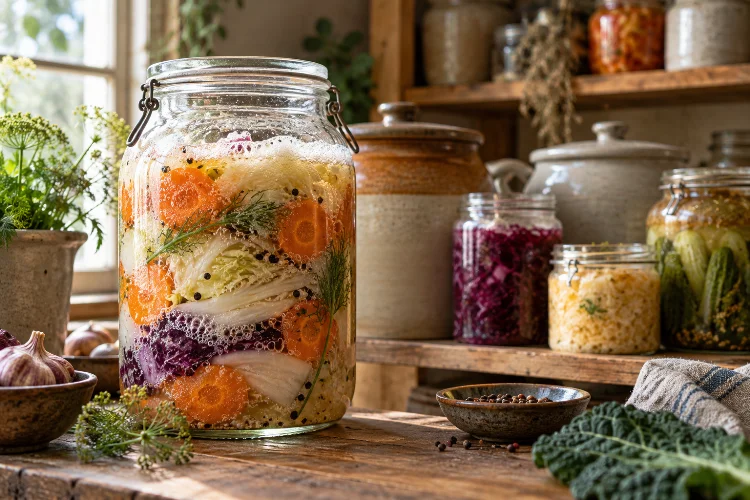
A jar of fermenting vegetables may look quiet from the outside, but inside it is anything but inactive.
Millions of microorganisms can be competing, cooperating, consuming sugars, producing acids, releasing aromas, and gradually transforming raw ingredients into something completely different.
Traditional fermentation practices learned to manage these microscopic communities long before anyone knew bacteria or yeasts existed.
Understanding microbial diversity in heritage fermentation practices helps explain why sourdough from one village can taste different from bread made somewhere else, or why traditional cheeses, fermented soy products, pickles, beverages, and fish sauces develop such distinctive personalities.
Fermentation is not controlled by one universal microbe. Depending on the food, bacteria, yeasts, molds, and other microorganisms may work alone or as complex communities.
Modern DNA sequencing has revealed just how diverse these ecosystems can be. Researchers now understand that raw ingredients, starter cultures, utensils, temperature, salt, climate, and even previous fermentation batches can influence which organisms become dominant.
Heritage fermentation is therefore partly a form of microbial ecology.
Fermented Foods Are Living Microbial Ecosystems
Fermentation is commonly defined as food transformation through desired microbial growth and enzymatic conversion of food components.
That definition covers an enormous range of foods, from yogurt and sourdough to miso, kimchi, fermented meats, beverages, and cheeses.
But not every fermentation works in the same way.
Some are dominated by a relatively small number of microorganisms. Others depend on highly diverse communities in which several groups perform different jobs at different stages.
Traditional fermented foods can contain lactic acid bacteria, acetic acid bacteria, yeasts, filamentous molds, Bacillus species, and occasionally other microbial groups.
Think of the process as an ecosystem rather than a recipe.
One organism may create conditions that allow another to thrive. Another may release nutrients that neighboring microbes can consume.
What seems like a simple crock of fermenting food can actually contain an elaborate microbial community.
Lactic Acid Bacteria Create the Acidic Foundation
Lactic acid bacteria, often shortened to LAB, are among the most important organisms in traditional food fermentation.
They consume carbohydrates and produce lactic acid, gradually lowering the pH of the food. This creates the sourness associated with foods such as sauerkraut, kimchi, fermented vegetables, sourdough, and many cultured dairy products.
Acidity also changes the microbial environment.
As the pH drops, microorganisms that tolerate acidic conditions gain an advantage, while many undesirable organisms become less competitive.
That means LAB help shape both flavor and ecological succession.
They do not simply make food sour. Their metabolism can also contribute aroma compounds, texture changes, and other metabolites that influence the finished product.
Researchers examining traditional fermented foods around the world repeatedly identify genera of lactic acid bacteria alongside yeasts, molds, and other organisms.
In other words, acidity is often the foundation upon which a much more complicated microbial community develops.
Yeasts Add Alcohol, Aroma, and Ecological Complexity
Yeasts are famous for producing alcohol and carbon dioxide, but their role in heritage fermentation goes much further.
Species such as Saccharomyces cerevisiae consume sugars and convert them into ethanol and other metabolic products. This process is essential in bread, beer, wine, traditional beverages, and many mixed fermentations.
Other yeasts also contribute.
Research on traditional Ecuadorian fermented foods, for example, identifies interactions between Saccharomyces and non-Saccharomyces yeasts including Torulaspora, Hanseniaspora, and Metschnikowia.
These organisms can influence carbohydrate use, nitrogen metabolism, and aroma formation.
Yeasts often produce esters and other volatile compounds associated with fruity, floral, or fermented aromas.
Their relationship with bacteria can be equally important.
A yeast might break down nutrients that bacteria later consume. Bacteria may alter acidity in ways that affect yeast growth.
This microbial teamwork helps explain why naturally fermented products can taste more complex than foods produced through a single isolated culture.
Molds Can Act Like Microscopic Enzyme Factories
Mold sounds undesirable when it appears unexpectedly on food, but selected molds have played valuable roles in fermentation for centuries.
Traditional Asian fermentations provide especially clear examples.
Certain molds produce powerful enzymes capable of breaking starches into sugars and proteins into peptides and amino acids. Those smaller molecules can then be used by yeasts and bacteria or contribute directly to flavor.
This is central to fermentations involving koji and similar mold-based systems.
The mold is effectively preparing the raw material for the rest of the microbial community.
Recent reviews of traditional fermented food ecosystems list filamentous fungi alongside bacteria and yeasts as important members of these complex communities.
This division of labor is one reason fermented foods can develop extraordinary sensory depth.
One organism produces enzymes. Another consumes the sugars those enzymes release. A third transforms resulting compounds into acids, alcohols, or aroma molecules.
Complex flavor can emerge from cooperation.
Spontaneous Fermentation Reflects the Local Environment
Many heritage fermentations historically began without a commercially manufactured starter culture.
Instead, cooks created conditions that favored microorganisms already present on the ingredients, equipment, containers, household surfaces, or surrounding enviroment.
This is called spontaneous fermentation.
Research into traditional fermented foods has shown that microorganisms may originate from raw plant or animal materials, utensils, earthenware vessels, starter cultures, and the wider production environment.
That creates a fascinating connection between place and flavor.
Two communities can ferment similar ingredients but develop different microbial populations because their environments, climate, water, containers, and processing habits differ.
Temperature matters particularly strongly.
Salt concentration, oxygen availability, moisture, acidity, and fermentation duration further determine which organisms survive.
The microbial community is therefore selected by the entire process.
Traditional knowledge may describe these factors through practical instructions rather than microbiology: use this amount of salt, keep the jar here, use this vessel, and wait until it smells right.
Those instructions are actually ways of managing an invisible ecosystem.
Back-Slopping Preserves Microbial Communities Across Generations
One ingenious traditional technique is back-slopping.
Instead of beginning every fermentation completely from scratch, cooks transfer a small portion of a successful previous batch into fresh ingredients.
That old material acts as a starter.
It introduces microorganisms that are already adapted to the fermentation environment, potentially helping the next batch begin more predictably.
Modern research identifies back-slopping in foods including sourdough, sauerkraut, and kefir as one source of fermentation microorganisms.
The cultural significance is fascinating.
A starter passed between relatives or maintained by a household can represent biological continuity as well as culinary tradition.
People are literally maintaining microbial communities across time.
Kefir offers an especially dramatic example of communal fermentation. Nature has noted that kefir communities may contain dozens of species of lactic and acetic acid bacteria and yeasts, with metabolic interactions helping maintain ecological stability during fermentation.
A traditional starter is therefore not simply an ingredient.
It can be a miniature microbial inheritance.
Microbial Succession Means the Community Changes Over Time
A fermentation does not necessarily contain the same dominant organisms from beginning to end.
Its microbial population can change in stages.
Early organisms consume readily available nutrients and modify the surrounding environment. Their activity can change acidity, oxygen, alcohol concentration, temperature, or nutrient availability.
Those changes may eventually make conditions less favorable for the first organisms and better for another group.
This process is known as microbial succession.
Recent studies emphasize that traditional fermented food ecosystems are dynamic rather than static.
High-throughput sequencing and multi-omics technologies now allow researchers to track which microorganisms appear, disappear, or become dominant during different phases.
That matters for flavor.
A product sampled early may taste sweeter and fresher. Later stages might contain more acids, alcohols, esters, peptides, or other metabolites.
Time does not simply make fermented food “stronger.”
It changes who is doing the fermenting.
Microbial Diversity Helps Create Regional Food Identity
Traditional fermentation is deeply connected with cultural geography.
Different regions ferment different raw materials depending on what is locally available. Rice, millet, maize, cassava, soybeans, milk, fish, meat, vegetables, and fruit all support different microbial ecosystems.
A global review of fermented foods identified enormous microbial diversity across fermented cereals, legumes, vegetables, dairy foods, meats, fish, and alcoholic beverages.
African fermented foods provide another example.
Modern DNA-based research has revealed diverse microbial communities within traditional African products, highlighting organisms of potential importance for food quality, safety, and technological development.
This means culinary identity can exist at the microbial level.
The recognizable character of a fermented product may depend partly on organisms maintained by local techniques, ingredients, vessels, and environmental conditions.
Losing the traditonal process can therefore mean losing microbial biodiversity as well as a recipe.
Modern Science Is Revealing Microbes Traditional Cooks Could Never See
For centuries, cooks evaluated fermentation through smell, taste, appearance, texture, bubbling, and experience.
Modern laboratories can now examine it at a completely different level.
High-throughput DNA sequencing can identify microorganisms that are difficult or impossible to grow using conventional laboratory techniques.
Metagenomics can provide information about community genes, while metabolomics examines the compounds those organisms produce.
Researchers are increasingly combining these methods through multi-omics analysis.
A 2026 review describes the use of metagenomics, metatranscriptomics, proteomics, metabolomics, flavoromics, and other approaches to understand traditional fermentation ecosystems.
Another recent review argues that these technologies may help build more reproducible microbial consortia while maintaining desirable fermented-food characteristics.
The challenge is balance.
Standardization can improve consistency and safety, but simplifying a diverse fermentation too aggressively may also remove microorganisms that contribute subtle flavors or ecological resilience.
Modern science is therefore not simply replacing heritage knowledge.
At its best, it helps explain what generations of cooks already learned through observation.
Understanding microbial diversity in heritage fermentation practices reveals that traditional fermented foods are really living ecosystems shaped by microorganisms, ingredients, environment, and human knowledge.
Lactic acid bacteria build acidity, yeasts produce alcohol and aromatic compounds, while molds release enzymes that unlock new nutrients and flavors. These organisms interact, compete, cooperate, and change throughout the fermentaion process.
Traditional techniques such as spontaneous fermentation and back-slopping helped communities manage this diversity long before microbes could be seen.
Next time you eat sourdough, kimchi, fermented soy, cheese, kefir, or another traditional ferment, think beyond the ingredient list.
Its distinctive character may come from an entire invisible community – and understanding that community offers a deeper appreciation of why heritage fermentation is so difficult to replicate perfectly.
