
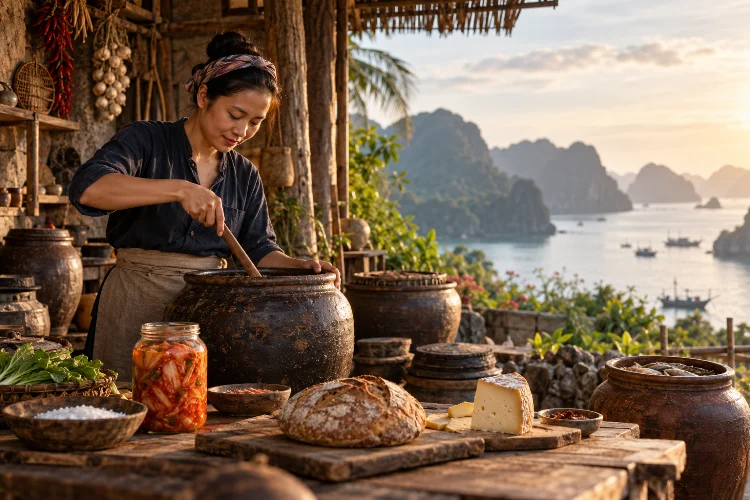
Fermented foods have an interesting habit of tasting like the places where they come from. A soybean ferment made in Korea can taste noticeably different from one produced in China or Japan.
Fermented fish from Maluku develops a completely different identity from Southeast Asian shrimp paste, while sourdough, cheese, kimchi, and traditional beverages often carry characteristics associated with specific communities.
So why does this happen?
Understanding why traditional fermented foods develop unique regional flavors means looking beyond the raw ingredients.
Fermentation is influenced by microorganisms, climate, salt concentration, water, temperature, containers, starter cultures, and the traditions used to manage them.
Modern research shows that fermented foods can contain remarkably complex microbial ecosystems.
Some are dominated by a few species, while others contain interacting populations of bacteria, yeasts, and fungi whose metabolic activity creates acids, alcohols, peptides, esters, and other flavor compounds.
Regional flavor therefore develops from an interaction between biology, geography, and human knowledge.
Local Microbes Create a Fermentation Fingerprint
One of the biggest reasons traditional fermented foods taste different is microbial diversity.
Fermentation is powered by microorganisms. Depending on the food, these may include lactic acid bacteria, yeasts, molds, acetic acid bacteria, Bacillus species, or salt-tolerant microbes.
Each group performs different chemical work.
Lactic acid bacteria turn carbohydrates into acids. Yeasts may create alcohols and aromatic compounds. Molds release enzymes that break down proteins and starches, while other organisms transform these breakdown products into additional flavors.
Traditional fermentation often uses microorganisms already present on raw ingredients, equipment, starter materials, or within the production environment.
This creates what could almost be called a microbial fingerprint.
Recent research on fermented-food ecosystems emphasizes that community composition can be shaped by the substrate, surrounding environment, starter material, and interactions between organisms.
Change that community, and you can change the taste.
Local Ingredients Give Microbes Different Raw Materials
Microorganisms cannot create flavor from nothing.
They need raw materials.
Regional agriculture therefore strongly affects fermentation. Rice, soybeans, cassava, milk, fish, shrimp, cabbage, millet, grapes, and dozens of other foods each contain different combinations of carbohydrates, proteins, fats, minerals, and aromatic compounds.
Those differences determine what microbes can metabolize. Research on traditional Indonesian fermented foods provides a useful example.
Scientists studying tape ketan, tape singkong, and terasi found substantial differences in microbial communities between fermented rice, cassava, and shrimp-based products. The foods also showed different functional microbial profiles.
Terasi, for instance, supports microbial communities adapted to salty, protein-rich seafood fermentation.
Tape behaves very differently because starch-rich rice or cassava encourages organisms capable of breaking carbohydrates into simpler sugars.
Regional flavor begins with what grows, swims, or is raised locally.
Fermentation then transforms that local ingrediant into something even more distinctive.
Climate Changes Which Microorganisms Thrive
Traditional fermentation existed long before refrigerators and digitally controlled fermentation rooms.
That meant climate mattered enormously.
A fermentation taking place in a warm tropical environment experiences different conditions from one developing during a cold European winter. Temperature affects microbial growth rate, chemical reactions, enzyme activity, and which organisms can successfully compete.
A large-scale analysis of traditional fermented foods found that geographic region, climatic zone, substrate, and raw materials were major drivers of microbial diversity and community composition.
Temperature can also directly affect flavor development.
Research on soy sauce fermentation found that fermentation temperature influenced microbial succession, including the growth of lactic acid bacteria associated with acid production and flavor formation.
Traditional producers often learned to work with seasonal temperature changes rather than eliminating them.
A ferment might traditionally begin during a particular month because generations of experience showed that the weather produced better results.
What looked like cultural habit could actually be practical microbial management.
Salt Does More Than Make Fermented Food Salty
Salt is one of the most important tools in traditional fermentation.
It obviously contributes flavor, but its bigger role is ecological.
Different microorganisms have different tolerances for salt. Increasing salinity can suppress some microbes while allowing salt-tolerant organisms to continue growing.
This means salt helps select which microbial community develops.
Traditional Korean ganjang provides an interesting example. It is produced through spontaneous fermentation using soybeans, water, and salt rather than depending completely on standardized commercial cultures.
Studies have linked different microorganisms within ganjang communities with specific sensory characteristics, including sour, musty, bitter, and savory notes.
The amount of salt therefore changes more than seasoning.
It changes microbial competition.
Slight differences in salinity between households or regions can gradually push fermentation in different directions.
That can influence acidity, aroma, texture, and umami.
A measurement that looks simple on paper can shape an entire microbial ecosystem.
Starter Cultures Carry Flavor Across Generations
Some traditional fermentations rely on spontaneous microbes, while others use established starter cultures.
These starters can be surprisingly complex.
A portion of a previous batch may be added to new ingredients, a technique often called back-slopping. Other cultures are maintained as grains, cakes, molds, liquids, or mixtures containing several microbial species.
The starter gives the new fermentation a microbial head start.
Instead of waiting for random environmental organisms to become established, cooks introduce microbes already adapted to the process.
Over many generations, this can create continuity.
The same household or village may repeatedly select microbial communities that thrive under its particular combination of ingredients, water, salt, temperature, and equipment.
Modern industrial fermentation often replaces these mixed communities with standardized starter strains because they give predictable results.
That improves consistency, but recent research notes that the unique sensory profiles of many heritage foods often depend on open and complex microbial ecosystems.
A traditonal starter can therefore act almost like a living culinary inheritance.
Fermentation Vessels Can Influence the Final Flavor
A clay jar, wooden barrel, stone container, stainless-steel tank, or plastic bucket does not necessarily create the same fermentation environment.
Vessels affect oxygen exposure, temperature stability, moisture loss, and contact with microorganisms living on the container itself.
Older porous vessels may retain resident microbial communities between batches.
Wood can create additional niches where microbes survive, while earthenware may behave differently from sealed modern containers when it comes to gas exchange and thermal stability.
The vessel also shapes human technique.
A producer using a large clay jar may stir, seal, expose, or age food differently from someone working with an industrial tank.
Those decisions influence microbial succession.
Soy sauce demonstrates how complicated this process can become. Traditional production typically involves fungal koji followed by a salty mash fermentation in which bacteria and yeasts transform peptides, amino acids, and sugars into acids and aroma compounds.
The container does not work alone.
It becomes one part of an entire fermentation environment.
Microbial Succession Builds Flavor in Stages
A mature fermented product is not necessarily created by the same microorganisms that dominated at the beginning.
Fermentations often move through microbial succession.
One population grows first, consumes available nutrients, and changes the environment. Acidity may increase, oxygen may decrease, alcohol may accumulate, or new nutrients may become available.
Different organisms then become more competitive.
That means flavor develops in stages as well.
Research on Sichuan-style black soybean soy sauce followed six months of natural fermentation and identified 132 volatile compounds.
Changes in microbial succession were associated with evolving acids, amino compounds, esters, alcohols, aldehydes, and other flavor molecules.
This is why time matters so much.
A young ferment can taste sharp, fresh, or simple. Months later, the same product may become deeply savory, fruity, smoky, earthy, or slightly alcoholic.
Aging is not just waiting.
It is giving successive microbial communities time to modify the food.
Regional Fermented Foods Reflect Cultural Decisions
Microbiology explains part of regional flavor, but humans decide how the microbes are managed.
Communities determine which ingredients are fermented, how much salt is used, whether food is sun-dried first, how long it ages, which starter is added, and when the finished product tastes “ready.”
These choices become cultural traditions.
Ina sua from Central Maluku is a good example. This traditional fermented fish preparation uses fish and salt and developed partly as a way to preserve food for periods when fresh fish was unavailable. It is also associated with community events and local identity.
Its distinctive taste is therefore connected to more than microorganisms.
It reflects the fish available locally, environmental conditions, preservation needs, preparation methods, and social traditions surrounding the food.
The same principle appears around the world.
Kimchi is not merely fermented cabbage. Traditional soy sauce is not simply fermented soybeans. Cheese is not merely fermented milk.
Every region adds decisions that reshape the biology.
Complex Microbial Communities Create Complex Aromas
Fermented foods can produce extraordinarily diverse aromas because microbial communities generate many different metabolites.
Some create fruity esters. Others form organic acids, alcohols, sulfur compounds, aldehydes, ketones, or peptides.
Soy sauce is a particularly good example.
Its sensory complexity comes from the combined action of molds, lactic acid bacteria, yeasts, enzymes, raw materials, and long fermentation.
Reviews of soy sauce chemistry describe a broad range of compounds contributing caramel-like, smoky, floral, fruity, malty, and savory characteristics.
Traditional sufu fermentation shows a similar relationship between microbial succession and characteristic aroma compounds. Different microbial groups become important during early and late fermentation stages.
This complexity explains why industrial shortcuts sometimes reproduce the basic taste of a fermented food but struggle to recreate every aromatic detail.
The deeper character often comes from many organisms doing slightly different jobs.
Traditional Flavor Is Difficult to Standardize Completely
Modern producers understandably want predictable fermentation.
Consistency matters for safety, shelf life, manufacturing, and customer expectations.
Yet perfect standardization creates an interesting challenge.
Traditional regional foods often became distinctive precisely because their fermentations were not completely standardized. Local ingredients changed slightly with harvests, seasonal temperatures varied, and microbial communities shifted between batches.
Modern technology can identify and control many of those variables.
That makes production safer and more reliable.
However, researchers are increasingly studying how to preserve complex microbial consortia while improving control rather than simply reducing every fermentation to a single organism.
The goal is not to romanticize unpredictability.
It is to understand which variations create valuable sensory diversity and which introduce unnecessary risk.
Regional flavor sits somewhere between consistency and controlled variation.
Understanding why traditional fermented foods develop unique regional flavors reveals that fermentation is shaped by an entire ecosystem.
Local ingredients provide different nutrients, while climate, salt, vessels, starter cultures, and fermentation time select different microbial communities.
Bacteria, yeasts, and fungi then produce acids, alcohols, peptides, and aromatic compounds that gradually create a recognizable regional character.
Human traditions guide that process. Generations of cooks learned when to ferment, what vessel to use, how much salt to add, and when a product tasted right.
The next time you try a traditional ferment, compare it with a version from another region. Pay attention to acidity, aroma, texture, saltiness, and umami. Those differences may reveal not just another recipe, but a completely different microbial and cultural landscape.
