
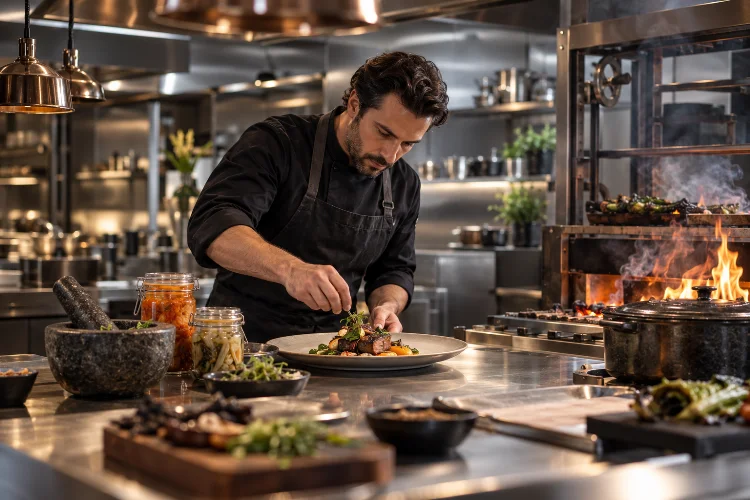
Walk into an ambitious modern restaurant and you may see precision induction cooktops, vacuum sealers, temperature-controlled ovens, and high-speed blenders.
Look more closely, however, and many of the flavors coming from that kitchen are built with techniques that are hundreds or even thousands of years old.
Fermentation, smoking, open-fire cooking, stone grinding, slow braising, pickling, and clay-oven roasting were developed long before chefs understood the chemistry behind them.
Early cooks used these methods because they made food safer, more digestible, easier to store, or simply more delicious. Today, those same processes are being refined with modern equipment and scientific knowledge.
Understanding traditional cooking techniques that still shape modern gastronomy reveals an interesting truth: culinary innovation rarely means abandoning the past. More often, chefs take an old idea, understand why it works, and apply it with greater precision.
From Michelin-starred kitchens to neighborhood bakeries, ancient food knowledge continues to influence how contemporary chefs create texture, aroma, acidity, smoke, and deep savory flavor.
Fermentation Turned Preservation Into Flavor Design
Fermentation began largely as a practical way to preserve food, but it eventually became one of gastronomy’s most powerful flavor-building tools.
The FAO describes fermentation as one of the world’s oldest food preservation technologies. Bread, cheese, wine, fermented vegetables, and countless regional foods have been produced for thousands of years, often using knowledge passed between generations.
During fermentation, microorganisms transform components such as sugars into acids, gases, alcohols, and aromatic compounds. What begins as an ordinary ingredient can develop remarkable complexity.
Think about cabbage becoming kimchi or sauerkraut, milk becoming yogurt or cheese, and soybeans becoming miso or soy sauce.
Modern chefs increasingly use controlled fermantation for the same reason traditional cooks valued it: transformation.
Restaurant kitchens may carefully monitor temperature, salinity, acidity, and fermentation time to produce predictable results while preserving the character of an ancient process.
The difference is control, not principle.
Open-Fire Cooking Still Defines the Taste of Luxury Restaurants
Cooking over fire may be humanity’s oldest serious culinary technology, yet it has become fashionable again in contemporary gastronomy.
The appeal goes beyond nostalgia.
Direct flames, glowing charcoal, and hot embers create intense heat that changes the surface of food rapidly. Browning reactions generate complex aromas, while wood and charcoal can contribute subtle smoky compounds.
Modern chefs use these effects with extraordinary precision.
Vegetables might be blistered directly over coals, meat positioned at different heights above an open flame, or fruit roasted near embers to concentrate natural sugars.
Even fine-dining restaurants equipped with modern ovens often install custom grills because electric heat cannot perfectly reproduce the interaction between fire, smoke, fat, and food.
What once represented necessity now represents deliberate flavor engineering.
Smoking Evolved From Storage Method to Culinary Signature
Before refrigeration, smoke helped communities preserve meat and fish while adding a characteristic flavor.
The technique works alongside drying, salting, and other preservation processes. Traditional societies often developed specific combinations of local woods, temperatures, and smoking times suited to available foods.
Modern gastronomy has separated smoking from its original survival function.
Chefs now smoke butter, salt, vegetables, cheese, sauces, cocktails, and even desserts. The goal may be aroma rather than long-term preservation.
This development shows how older food-processing methods can gain completely new roles.
Traditional smoking might have continued for hours or days. A modern chef may expose an ingredient to smoke for only several minutes because the desired effect is a delicate aromatic layer rather than preservation.
The underlying technique remains familiar, but the purpose has changed.
Slow Cooking Proves That Time Is Still a Culinary Ingredient
Pressure cookers and high-powered appliances can dramatically reduce cooking times, yet slow cooking remains essential across world cuisine.
There is a simple reason: certain transformations need time.
Long, gentle cooking softens tough connective tissue in meat, allows flavors to integrate, and changes the texture of vegetables, legumes, and sauces. Traditional stews, braises, curries, clay-pot dishes, and stocks all rely on variations of this principle.
Older cooks often placed pots near low fires or retained heat for hours because fuel had to be managed carefully.
Modern kitchens reproduce that environment with temperature-controlled ovens, induction burners, or sous-vide equipment. The technology may be new, but the fundamental concept is traditonal: maintain relatively gentle heat and allow time to do the work.
Contemporary chefs have simply made the process easier to measure.
A grandmother might judge a stew by aroma and texture. A restaurant chef might use temperature probes and exact timings.
Both are managing the same transformation.
Nixtamalization Shows How Ancient Knowledge Anticipated Food Science
One of the most impressive examples of traditional culinary technology comes from Mesoamerica.
Nixtamalization involves cooking and soaking maize in an alkaline solution, traditionally using lime or wood ash. The treated maize is then rinsed and ground into masa used for foods such as tortillas and tamales.
Scientific research identifies nixtamalization as an ancient process developed by Indigenous Mesoamerican civilizations that remains widely used today.
Its effects go far beyond texture.
The process changes the physical properties of maize, creates the characteristic flavor and flexibility required for good masa, and alters nutritional properties.
Research on traditional tortilla production shows that nixtamalization affects starch behavior, texture, firmness, rollability, and other sensory characteristics.
Modern food manufacturers now reproduce versions of this ancient technology at industrial scale.
That is remarkable when you consider that the original cooks developed the process without modern chemistry laboratories. They discovered through accumulated experience that treating maize in a particular way produced better food.
Science arrived much later to explain why.
Drying and Curing Created Concentrated Flavors
Removing moisture is another ancient technique that continues to shape modern gastronomy.
Traditional drying made seasonal foods available for longer periods. FAO materials on traditional food processing describe drying as a way of producing stable, low-moisture foods suitable for storage and transportation.
But drying also changes flavor.
Sun-dried tomatoes become sweeter and more concentrated than fresh tomatoes. Dried mushrooms develop intense savory characteristics, while dried fruits concentrate sugars and aromatic compounds.
Curing produces similar transformations.
Salted and air-dried meats, preserved fish, cured egg yolks, and aged cheeses demonstrate how controlled moisture loss can generate textures and aromas impossible to achieve in fresh ingredients.
Modern chefs often borrow these methods for small components rather than long-term food security.
A restuarant might dehydrate mushrooms into seasoning powder, cure egg yolks until they can be grated over pasta, or dry fruit to create concentrated acidity and sweetness.
A preservation technique becomes a flavor amplifier.
Clay Pots and Traditional Ovens Still Influence Heat Management
Modern stainless steel cookware is excellent at conducting and controlling heat, yet clay vessels remain important in many cuisines.
Earthenware heats differently from thin metal.
Depending on its construction, a clay pot can retain heat, distribute it gradually, and maintain a moist cooking environment. This makes it useful for slow-cooked rice, beans, stews, meats, and braises.
Traditional ovens offer another example.
Tandoor-style cooking exposes breads and meats to extremely high radiant heat, producing rapid browning while preserving moisture inside. Similar principles appear in wood-fired bread ovens and other enclosed high-temperature cooking systems.
Contemporary chefs frequently recreate these thermal environments using specially designed ovens.
The reason is not simply visual tradition. Different cooking vessels and heat sources produce different physical results.
Understanding cookware is therefore part of understanding flavor.
Grinding, Pounding, and Crushing Affect More Than Texture
A blender can turn spices or herbs into paste within seconds, but speed does not always produce the same result as traditional grinding.
Mortars, pestles, grinding stones, and hand mills crush ingredients differently from rotating blades.
Pounding herbs can rupture plant cells while maintaining a relatively coarse texture. Grinding toasted spices releases volatile aromatic oils gradually, while stone-ground grains may retain different particle structures compared with highly refined industrial flour.
This matters in preparations such as curry pastes, pesto, sambal, mole, spice blends, and masa.
Modern chefs sometimes return to hand-processing not because machines are unavailable but because the result can feel different.
Texture is part of taste perception.
A rough sauce catches differently on food than a perfectly smooth puree. Crushed spices may release aroma in stages during cooking rather than immediately.
Old kitchen tools can therefore offer something extremely modern chefs value: control over sensory detail.
Traditional Food Knowledge Is Becoming Part of Modern Innovation
The continued influence of traditional cooking extends beyond individual techniques.
UNESCO emphasizes that culinary heritage consists of living knowledge and practices transmitted between generations, rather than simply lists of traditional dishes. Around fifty food-related cultural practices are represented on UNESCO’s intangible cultural heritage lists.
Japanese Washoku provides a good example.
UNESCO describes it as a collection of knowledge, skills, practices, and traditions connected with producing, processing, preparing, and consuming food, with knowledge transmitted through families and communities.
Modern gastronomy increasingly treats this accumulated knowledge as a source of innovation rather than something outdated.
The FAO has similarly highlighted how Indigenous fermentation knowledge can coexist with modern science and food-safety research.
The most interesting culinary future may therefore come from combining both worlds: traditional observation and modern measurement.
Traditional cooking techniques continue to shape modern gastronomy because the fundamental problems of cooking have not changed. Chefs still need to transform texture, concentrate flavor, preserve ingredients, control heat, and create appealing aromas.
Fermentation provides acidity and umami, fire produces smoke and browning, slow cooking develops tenderness, while nixtamalization demonstrates the sophistication of Indigenous food science.
Drying, curing, clay-pot cooking, and manual grinding offer additional ways to manipulate texture and flavor. Modern equipment makes these processes more predictable, but it rarely makes their basic ideas obsolete.
The next time you try a contemporary dish, look beyond the presentation and examine its preperation. You may discover that its most innovative flavor comes from a technique cooks understood centuries before modern gastronomy had a name.
