
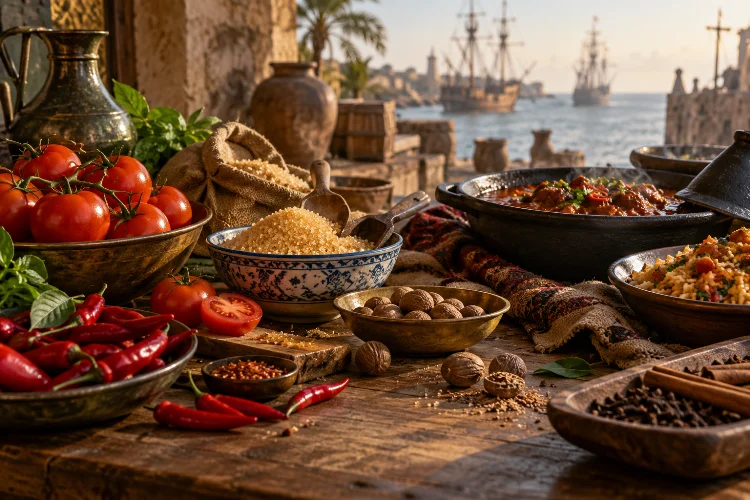
Look closely at almost any regional cuisine and you may find an ingredient that originally came from somewhere completely different.
Tomatoes feel inseparable from Italian cooking, chile peppers define dishes across much of Asia, sugar became central to European desserts, and nutmeg appears in foods thousands of kilometers from the Indonesian islands where it originated.
These connections did not happen overnight.
Understanding how colonial trade influenced modern regional food traditions means examining several centuries of commerce, conquest, forced labor, migration, plantation agriculture, and cultural adaptation.
European colonial expansion accelerated movements of ingredients that had already been occurring through older African, Asian, Mediterranean, and Indian Ocean trading networks.
The result was a dramatic restructuring of the global pantry.
Some ingredients became everyday staples. Others entered local dishes and eventually became symbols of regional identity.
Yet this culinary exchange also carried enormous human costs, particularly through slavery, displacement, monopolies, and exploitative plantation systems.
Modern cuisine therefore holds two histories at once: creative cultural adaptation and the unequal systems that helped move food around the world.
Colonial Trade Made Local Kitchens Increasingly Global
Long before European colonial expansion, merchants were already carrying spices, grains, fruits, and culinary knowledge across vast distances.
UNESCO describes the Silk Roads as interconnected land and maritime networks through which commodities, technologies, ideas, and cultural practices circulated across Eurasia.
Maritime spice routes linked Asian producers with consumers far beyond the regions where those ingredients originated.
Colonial powers did not invent this international exchange. What they did was reorganize and intensify it.
Portuguese, Dutch, British, Spanish, and French empires attempted to control strategic ports, agricultural regions, shipping corridors, and valuable commodities. Products such as pepper, sugar, tea, coffee, cloves, cinnamon, and nutmeg became deeply tied to imperial commerce.
That changed ordinary cooking.
Ingredients that had once been extremely expensive could eventually reach much larger markets. Repeated access encouraged cooks to experiment with them until imported foods were absorbed into established regional dishes.
Over generations, the foreign ingredient stopped feeling foreign.
The Columbian Exchange Rewrote Regional Flavor Profiles
Few historical events transformed food as dramatically as the movement of plants, animals, and other biological resources between the Americas and the Old World after the late fifteenth century.
Foods originating in the Americas included tomatoes, potatoes, maize, cacao, and chile peppers. After crossing the Atlantic, many were gradually incorporated into European, African, and Asian cuisines.
The transformation was remarkable.
Tomatoes initially encountered resistance in parts of Europe before becoming strongly associated with Mediterranean dishes.
Smithsonian notes that tomatoes and potatoes, both transferred from the Americas, eventually became emblematic of European cuisines that had previously existed without them.
Chile peppers produced an even more dramatic culinary journey.
Today, imagining many Indian, Thai, Korean, Sichuan, or Indonesian dishes without chile heat is difficult. Yet Capsicum peppers originated in the Americas.
Once introduced through early modern maritime trade, local cooks did not simply copy American recipes. They integrated chiles into existing spice systems, creating entirely new flavor combinations.
A foreign crop had become a regional signature.
The Spice Trade Reshaped Southeast Asian and European Food History
For European colonial powers, spices were not casual additions to dinner. They were valuable commercial commodities worth fighting over.
Maluku in present-day Indonesia became particularly important because of cloves, nutmeg, and mace.
UNESCO identifies the Banda Islands as the original major source of nutmeg and mace during the period of Portuguese, English, and Dutch competition.
During the seventeenth century, the Dutch established a highly controlled plantation and trading system in an effort to monopolize nutmeg production.
The wider Indonesian spice routes also connected producers with merchants from China, South Asia, the Middle East, North Africa, and later Europe.
These comercial networks affected cuisine at both ends.
European cooks gained more regular access to Asian aromatics, incorporating spices into meat dishes, pastries, drinks, preserved foods, and sauces. Meanwhile, colonial ports in Asia became environments where different culinary communities interacted.
The exchange was not equal or peaceful. Monopoly systems, military conquest, and coercive labor were central to parts of the trade.
Recognizing that history matters when discussing why certain spices became global ingredients.
Sugar Changed More Than Desserts
Few ingredients reveal the darker relationship between colonial trade and food more clearly than sugar.
Europeans introduced sugarcane cultivation into parts of the Americas, and plantations expanded rapidly across the Caribbean and South America. By the eighteenth century, British and French Caribbean plantations were major global sugar producers.
The system depended heavily on enslaved African labor.
As production increased, sugar gradually changed from an expensive luxury into a much more widely consumed ingredient. It transformed pastries, preserves, candies, drinks, and everyday eating habits.
Sugar also paired particularly well with another group of increasingly popular colonial commodities: tea, coffee, and chocolate.
The Smithsonian’s National Museum of American History notes that consumers began adding sugar to these bitter hot beverages, while molasses and sugar-industry byproducts also supported the growth of rum production.
What now looks like a simple cup of sweetened tea therefore reflects a much larger historical network involving plantations, shipping, consumer demand, and forced labor.
Colonial Ports Became Unexpected Centers of Culinary Mixing
Colonial trade did not move only ingredients. It moved people.
Sailors, enslaved Africans, merchants, soldiers, plantation workers, administrators, migrants, and local communities encountered one another in trading cities and port settlements.
Those interactions transformed regional recipies.
People adapted familiar foods using whatever was available locally. African cooking knowledge influenced foods across the Atlantic world.
European settlers learned from Indigenous agricultural systems. Asian merchants and labor communities brought ingredients and preparation methods into colonial cities.
Historical accounts of colonial American food, for example, describe regional eating patterns developing from European foods, Indigenous knowledge, African influences, and commodities obtained through international trade.
This mixing did not create one uniform cuisine.
Instead, different places produced different outcomes depending on their population, environment, economy, and trading connections.
That is why colonial-era culinary influence looks very different in Jamaica, Indonesia, India, Brazil, or coastal North America.
Each region transformed global ingredients through local experience.
Plantation Economies Created New Food Systems
Colonialism also changed what land was used to grow.
Rather than producing primarily for nearby communities, large areas were reorganized around export commodities such as sugar, tobacco, coffee, cacao, spices, and later other commercial crops.
This altered local economies and diets.
In the Caribbean, sugar plantations became highly specialized production systems. The Smithsonian describes Caribbean islands as major centers of sugar production whose profitability depended on the forced labor of millions of enslaved people brought across the Atlantic.
The Dutch East India Company pursued similar commercial control in parts of Asia, although the crops, labor arrangements, and local circumstances differed.
The VOC established monopolies and political control around highly profitable commodities including nutmeg, mace, cloves, and pepper.
These systems helped create global demand that survives today.
Modern supermarket shelves filled with sugar, coffee, chocolate, tea, and spices may look ordinary, but their global availability developed partly through historical systems of empire and plantation production.
Imported Ingredients Eventually Became “Traditional”
One of the strangest effects of colonial food exchange is how quickly societies can forget that an ingredient was once foreign.
Consider the tomato.
Italian cuisine existed long before tomatoes arrived from the Americas. Yet several centuries of adaptation made tomato sauces so culturally important that many people now instinctively associate tomatoes with Italy.
Chile peppers tell a similar story across Asia.
Local cooks combined the new crop with pre-existing traditons involving peppercorns, ginger, aromatic roots, fermented sauces, spices, and herbs. Instead of replacing older culinary systems, chile became another layer within them.
This pattern demonstrates something important about authenticity.
Traditional food does not have to remain unchanged forever. A culinary tradition can absorb something unfamiliar, reinterpret it, and eventually treat it as an essential part of regional identity.
Cuisine is historical precisely because it evolves.
Colonial Food History Still Shapes What We Eat Today
Many modern flavor combinations make more sense once their trade history becomes visible.
Sweet tea reflects connections between Asian tea, plantation sugar, and global shipping. European chocolate traditions depended on cacao originating in the Americas and sugar produced through colonial systems.
Caribbean rum developed from the byproducts of the sugar industry.
Nutmeg from Banda traveled into European baking and beverages, while American chile peppers became essential to cuisines thousands of kilometers away.
None of these examples means colonial trade alone created modern regional cuisine.
Local communities were active participants who selected, rejected, substituted, and transformed imported ingredients. Indigenous knowledge, pre-colonial trade, migration, environmental conditions, and household creativity remained equally important.
That distinction matters.
Colonial systems moved ingredients on an unprecedented scale, but cooks made those ingredients culturally meaningful.
Understanding how colonial trade influenced modern regional food traditions reveals that many familiar cuisines are products of centuries of movement and adaptation.
The Columbian Exchange relocated crops such as tomatoes and chiles.
European empires competed for Asian spices, while plantation systems expanded sugar production and reshaped consumption across the Atlantic world. Ports and migrant communities then combined ingredients and cooking knowledge in unexpected ways.
These exchanges produced remarkable culinary diversity, but they were also connected to conquest, monopolies, slavery, and displacement.
The next time you cook with tomato, chile, sugar, nutmeg, or another globally familiar ingredient, look into where it originated and how it reached your region. The history behind one everyday recipe can reveal a surprisingly large piece of world history.
