
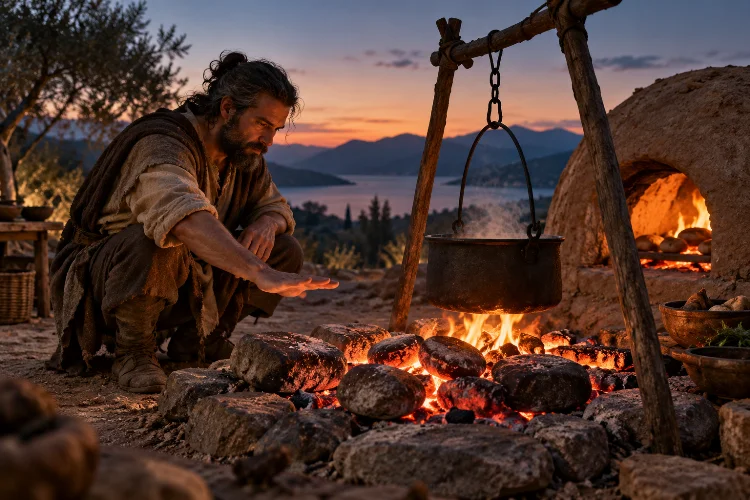
Before thermometers, electric ovens, or induction cooktops existed, cooks still needed to solve the same problem we face today: how do you give food exactly the right amount of heat?
They answered that question with experience rather than digital controls. A cook learned to recognize the color of glowing coals, feel radiant heat with a hand, judge how quickly steam escaped from a pot, or understand how long heated stones would stay warm underground.
Exploring ancient heat control in traditional food preparation shows just how sophisticated these methods could be.
Archaeological evidence reveals cooking systems that used hearths, stone-lined pits, domed ovens, ceramic vessels, and carefully managed fires thousands of years ago.
The equipment might appear simple compared with a modern kitchen, but the thinking behind it was anything but basic. Traditional cooks manipulated distance, insulation, airflow, fuel, moisture, and stored heat with remarkable precision.
In many cases, modern ovens simply automate principles people had already discovered through generations of observation and practice.
Fire Management Was the First Temperature Control System
An open fire might look uncontrolled, but experienced cooks can create several cooking zones from a single flame.
Freshly burning wood produces strong direct heat, while glowing embers create a steadier source of radiant energy. Moving food closer to or farther from the fire changes cooking intensity without adjusting any mechanical controls.
This meant ancient cooks could roast, grill, warm, dry, or slowly cook food around the same hearth.
Fuel selection mattered as well. Dense hardwoods generally burn differently from lightweight branches, grasses, or dung fuels.
Archaeological and ethnographic research in Central Asia shows that traditional mud-built ovens and hearths were operated with different fuel sources depending on local resources and cooking requirements.
Managing airflow was another form of temperature regulation. Adding fuel increased heat, spreading embers reduced concentrated flames, while partly covering a fire could slow combustion.
The cook effectively became the thermostat.
Instead of reading a number on a display, people learned to read the fire itself.
Hearths Allowed Cooks to Create Multiple Heat Zones
A hearth was much more than somewhere to build a fire.
Food could be placed directly above flames for intense cooking, positioned beside the fire for gentler roasting, buried under hot ash, or suspended farther away for gradual heating.
This gave cooks several temperatures at once.
The technique survives in modern barbecue and live-fire restaurants. Chefs still create zones of intense and moderate heat by rearranging charcoal or wood rather than changing a dial.
Older cooking traditions relied heavily on this spatial approach.
If meat browned too quickly, it could simply be shifted away from the flames. A pot that needed gentle simmering could sit near embers rather than directly above them.
This kind of heat controll required constant observation, but it also allowed remarkable flexibility.
The method explains why traditional recipes sometimes provide instructions such as “cook near the fire” or “place over glowing coals” rather than exact temperatures. The cook’s judgement was part of the recipe.
Earth Ovens Turned the Ground Into a Slow Cooker
One of the most impressive ancient heat-management systems was the earth oven.
Archaeological evidence shows that earth ovens using heated rocks appeared across many regions and have histories stretching thousands of years.
Research published in American Antiquity describes them as cooking systems designed to store thermal energy for long periods while conserving fuel.
The basic concept is clever.
A pit is heated with fire, often alongside stones capable of storing large amounts of heat. Food is placed inside with leaves or other protective material, then the oven is covered with earth.
Once sealed, the structure traps heat and moisture.
Experimental and archaeological studies show that heated stones can maintain cooking conditions for many hours.
Some traditional earth-oven foods required prolonged heating because slow cooking helped break down complex plant carbohydrates and made certain foods easier to digest.
Recent archaeological research from Wyoming has documented more than a thousand ancient thermal features, with oven designs varying according to food type, cooking duration, and required temperature.
It was essentially ancient thermal engineering.
Hot Stones Stored Heat Long After Flames Disappeared
Stones were one of the earliest practical tools for managing heat.
Unlike a flame that disappears when fuel burns out, certain rocks absorb thermal energy and release it gradually.
That made them useful in earth ovens, steaming pits, roasting surfaces, and even boiling systems.
Researchers studying hot-rock cooking note that heated stones could keep enclosed cooking environments warm for extremely long periods. In some documented earth-oven systems, rocks supported cooking lasting dozens of hours.
This solved another important problem: fuel efficiency.
In places where firewood was limited, storing heat inside rocks allowed cooks to get more cooking time from relatively small amounts of combustible material.
Hot stones could even heat liquids.
Before widespread metal cookware, stones heated in a fire could be transferred into containers filled with water or food. Archaeological experiments in the pre-Columbian Caribbean suggest that stone boiling was one of several heat-control techniques used there.
Modern sous-vide machines look much more technical, but the fundamental idea is surprisingly familiar: create a stable thermal environment and let steady heat transform food gradually.
Domed and Clay Ovens Concentrated Radiant Heat
Traditional ovens represented another major leap in temperature management.
Instead of allowing heat to escape into the open air, enclosed structures concentrated it.
Archaeological evidence from Late Neolithic Mesopotamia indicates that communities between roughly 6400 and 5900 BCE used domed ovens and ceramic trays for baking cereal-based foods.
Experimental reconstructions suggest temperatures could reach around 420°C during some forms of baking.
That is serious heat.
The principle remains visible in tandirs, tandoors, bread ovens, and traditional pizza ovens today.
UNESCO documents tandir ovens in Azerbaijan as both underground and above-ground pottery structures used for bread as well as some meat and poultry preparations. Knowledge of constructing and operating these ovens continues to be transmitted through families and apprenticeships.
The shape of the oven matters because its walls absorb heat and radiate it back toward the food.
This creates a powerful combination of radiant energy, hot air, and direct contact.
Bread can therefore cook incredibly quickly. UNESCO notes that Armenian lavash traditionally placed against the hot wall of a conical clay oven can bake in approximately 30 seconds to one minute.
No digital display is necessary when the oven itself acts as a thermal battery.
Clay Vessels Made Gentle Cooking Easier
Once ceramic cookware became widespread, cooks gained another useful way to regulate heat.
Clay vessels do not behave exactly like thin metal pans.
They generally warm more gradually and retain heat after the fire has weakened. Depending on their construction and use, they can create a stable environment suitable for stews, grains, legumes, and slow-cooked meat.
This allowed cooks to separate food from direct flame while still using fire as the energy source.
Instead of exposing ingrediants to intense heat, the vessel moderated the transfer of energy.
This opened the door to simmering and long-duration cooking.
A cook could also move a ceramic vessel between hotter and cooler areas of a hearth. Combined with lids, water, and controlled fuel, that provided surprisingly fine control over evaporation and tenderness.
The same principle appears in modern Dutch ovens, casseroles, and slow cookers.
The materials have changed, but the objective remains similar: stabilize heat so food cooks evenly.
Moisture Was Another Powerful Form of Heat Control
Traditional cooks did not regulate heat only by changing the fire.
They also controlled water.
Adding liquid limits how hot many foods become while moisture remains present. Steaming, simmering, boiling, and braising therefore create gentler cooking environments than dry roasting over intense flames.
Earth ovens used this principle particularly well.
Green leaves placed around food released moisture, while sealed pits trapped steam.
Researchers studying hot-rock cooking describe both dry baking and moist steaming systems, with water helping regulate the internal environment and reducing the chance that food would burn.
Clay pots could achieve something similar.
A covered vessel slowed evaporation, while an uncovered one concentrated sauces more quickly.
Traditional cooks could therefore manipulate heat indirectly simply by deciding how much moisture escaped.
This is a technique modern chefs still use constantly.
A covered braise stays humid and gentle. Remove the lid, and evaporation increases while flavors concentrate.
Ancient cooks might not have described this in terms of thermodynamics, but practical experiance taught them exactly what would happen.
Traditional Cooks Relied on Sensory Feedback Instead of Thermometers
Perhaps the most impressive element of ancient heat control was the human skill involved.
Without thermostats, cooks needed sensory signals.
They watched flame color, listened to sizzling, smelled browning food, observed steam, touched cookware, and judged the texture of ingredients as cooking progressed.
Knowledge was usually learned through repetition.
UNESCO’s documentation of traditional flatbread cultures across Azerbaijan, Iran, Kazakhstan, Kyrgyzstan, and Türkiye emphasizes that baking skills are transmitted through participation within families and from experienced practitioners to apprentices.
That learning process created highly refined intuition.
A traditional baker might know an oven is ready without ever measuring its temprature. The wall color, intensity of radiant heat, behavior of flour, or speed at which bread blisters can provide enough information.
Modern cooks depend heavily on numbers.
Traditional cooks often depended on patterns.
Both methods can be precise – they simply use different types of information.
Ancient Heat Control Still Shapes Modern Kitchens
Many contemporary cooking technologies are sophisticated versions of very old concepts.
A convection oven circulates hot air more efficiently, but enclosed ovens have been concentrating heat for millennia. Slow cookers recreate steady low-temperature cooking, while ceramic grills retain thermal energy much like older clay structures.
Modern barbecue uses fire zones and indirect heat.
Pizza ovens rely on thermal mass and radiant heat.
Sous-vide systems maintain stable temperatures for extended periods, echoing the ancient principle that gentle, sustained heat can transform tough ingredients.
What changed most dramatically is measurement.
Digital probes allow a chef to know that a piece of meat is exactly 58°C rather than judging it through touch. Automated ovens regulate airflow and fuel without constant supervision.
Yet the physical principles remain largely familiar.
Traditional cooks discovered through practice what modern culinary science explains through physics.
Understanding ancient heat control in traditional food preparation reveals that early cooking was far more technically sophisticated than it may first appear.
Hearths created multiple cooking zones, hot stones stored thermal energy, earth ovens trapped heat for hours, and clay vessels moderated direct flames.
Enclosed ovens intensified radiant heat, while moisture, insulation, airflow, and fuel selection gave cooks additional control.
What these systems lacked in electronics, they replaced with observation and practical knowledge.
The next time you grill over charcoal, bake bread in a stone oven, or slowly braise meat in a heavy pot, pay attention to how the heat actually moves. You may realize that many “modern” cooking principles were already being mastered by cooks thousands of years ago.
