
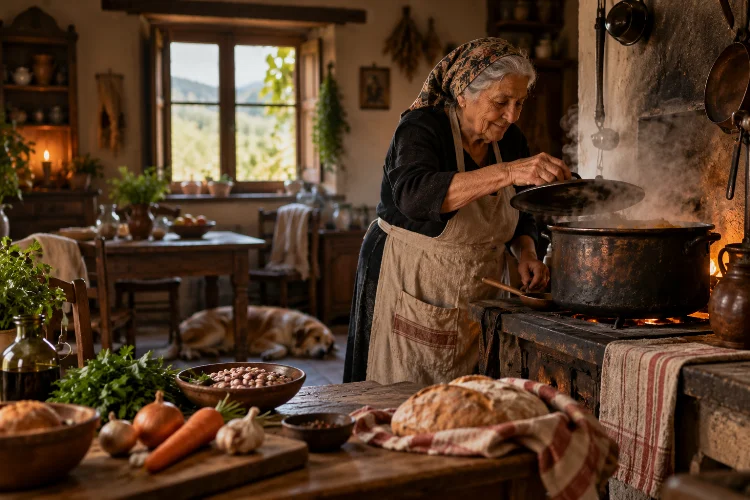
Some dishes simply refuse to be rushed.
A stew simmering for three hours, meat slowly braising in a covered pot, beans bubbling gently beside a fire, or a sauce reducing until every flavor feels concentrated can seem inefficient in a world of pressure cookers and fifteen-minute meals.
Yet slow cooking continues to appear in food traditions across Europe, Africa, Asia, the Middle East, and the Americas.
That persistence is not accidental.
Understanding why slow cooking remains central to many culinary traditions means looking beyond convenience.
Long cooking changes meat texture, softens tough plant foods, blends seasonings, concentrates aromas, and turns inexpensive ingredients into satisfying meals.
It also fits the historical realities of household cooking. Families often relied on durable pots, modest fires, seasonal ingredients, and foods that could feed several people at once.
Modern science now explains some of what traditional cooks discovered through experience. Gentle heat plus enough time can transform collagen, moisture, starches, and aromatic compounds in ways that rapid cooking does not always reproduce.
Slow food, in other words, survives because time itself can be an ingredient.
Slow Heat Turns Tough Meat Into Tender Food
One major reason slow cooking became so widespread is surprisingly economical: tough cuts of meat can become delicious when given enough time.
Muscles that perform more physical work generally contain substantial connective tissue. Cook them quickly and they can remain chewy. Expose them to controlled heat for longer periods, however, and collagen undergoes structural changes that can contribute to a softer texture.
Meat science research shows that the behavior of connective tissue depends on both temperature and heating time. Long-time cooking at relatively low temperatures can promote collagen denaturation and improve tenderness in collagen-rich meat.
Traditional cooks did not need laboratory equipment to discover this.
They could see that a relatively inexpensive shoulder, shank, brisket, or similar cut became dramatically easier to eat after hours in a pot.
That observation shaped dishes across countless food traditons. French braises, Italian ragù, Caribbean stews, Mexican barbacoa, Chinese red-cooked meats, and many other preparations rely on some version of the same relationship between heat and time.
Slow cooking made tougher ingredients useful rather than undesirable.
Time Allows Different Flavors to Merge
Tenderness is only part of the story.
Slowly cooked dishes often taste more integrated because ingredients have time to exchange flavor. Aromatics release compounds into fat and liquid, meat contributes savory juices, vegetables soften into sauces, and spices gradually distribute throughout the pot.
Consider onions in a stew.
At the beginning, they may taste sharp and distinct. After extended cooking, their structure breaks down and their sweetness becomes part of the surrounding sauce.
Spices change too.
A strongly aromatic spice added early may become softer and more integrated, while fresh herbs added near the end can provide contrast. This is why many traditional recipies build flavor in stages rather than throwing everything into the pot at once.
Slow cooking creates a progression.
The first layer comes from browning or frying. The second develops during simmering, and a final layer might come from herbs, acidity, fermented condiments, or fresh spices just before serving.
Complexity emerges gradually.
Slow Cooking Made Economical Ingredients More Valuable
Traditional cuisine has rarely been built exclusively around premium ingredients.
For much of history, households needed to make satisfying meals from what was affordable, seasonal, preserved, or locally abundant. Slow cooking was extremely useful in that environment.
Dried beans can become creamy. Tough meat becomes tender. Root vegetables soften and absorb broth. Small amounts of meat or fat can flavor a much larger quantity of grain, pulses, or vegetables.
This explains the importance of stews, soups, porridges, and braised dishes in so many cultures.
One pot could stretch ingredients across an entire household.
The technique could also reduce waste. Bones, connective tissue, mature vegetables, dried foods, and less fashionable cuts could still contribute flavor and nutrition when handled patiently.
Modern chefs may describe this as resourceful or nose-to-tail cooking.
Traditional households often simply called it dinner.
Gentle Cooking Creates Textures Fast Heat Cannot Easily Copy
High heat is excellent for browning, crisping, and charring, but it is not ideal for every ingredient.
Slow cooking creates a different family of textures.
Meat fibers gradually become tender, legumes soften, grains absorb liquid, sauces thicken, and vegetables can partially dissolve into broths.
These transformations help produce the comforting texture associated with dishes such as congee, dhal, cassoulet, pot roast, or long-simmered curries.
Temperature research helps explain why.
Studies of low-temperature, long-time cooking show that extended heating can change collagen structure while limiting some of the rapid muscle contraction associated with higher temperatures.
The final result depends heavily on the specific meat, temperature, and cooking duration.
Traditional braising achieves related effects without laboratory precision.
Liquid and a covered vessel create a moist environment, while moderate heat reduces the risk of aggressively drying the food.
It is a forgiving technique – which is another reason it survived.
One-Pot Cooking Fit Everyday Household Life
Slow cooking sounds labor-intensive, but it does not necessarily require constant attention.
Once a pot reaches a steady simmer, much of the actual work is being done by heat.
Historically, this made slow-cooked food compatible with households where people had other responsibilities. A pot could remain near a hearth while family members worked, cared for animals, farmed, traded, or completed domestic tasks.
The cookware mattered as well.
Heavy clay, stoneware, cast metal, and other heat-retaining vessels helped maintain relatively stable cooking conditions. Even after an intense fire declined, stored heat could continue affecting the food.
Modern Dutch ovens and slow cookers operate on a surprisingly familiar principle.
They maintain an enclosed, relatively stable environment that allows food to cook gradually with limited supervision.
Today we call that convenience. Historically, it was simply practical heat management.
Slow Food Became Connected With Community and Ritual
Food traditions survive for cultural reasons as much as culinary ones.
A dish that cooks for several hours naturally creates anticipation. Its preparation can bring people together and become associated with weekends, religious observances, harvests, weddings, festivals, or family gatherings.
UNESCO emphasizes that traditional culinary heritage includes knowledge, skills, social practices, and methods transmitted between generations rather than simply individual foods.
Around fifty food-related culinary practices are represented within its intangible cultural heritage framework.
Couscous traditions across Algeria, Mauritania, Morocco, and Tunisia illustrate this relationship.
UNESCO describes couscous preparation as a multi-stage process involving semolina preparation, steaming, cooking, specialized utensils, and knowledge commonly passed through observation and imitation. The tradition is also strongly associated with sharing and togetherness.
This social element matters.
A long-cooked meal can become more than preperation. It becomes an event around which family and community life is organized.
Different Cultures Developed Their Own Versions of Slow Cooking
The underlying principle is universal, but the results are remarkably diverse.
North African cooking may use earthenware vessels, aromatic spices, dried fruits, vegetables, and meat. East Asian kitchens developed braised dishes built around soy-based seasonings, rice wine, aromatics, or fermented products.
South Asian cooking includes long-simmered lentils, meat curries, and dishes where spices develop over several cooking stages.
European traditions contribute everything from French boeuf bourguignon to Hungarian-style stews and Italian ragù.
Across Latin America and the Caribbean, slow cooking appears in beans, braised meats, stews, and dishes shaped by Indigenous, African, European, and Asian influences.
These foods are not variations of one original dish.
They developed independently within different environments, ingredient systems, and cultural histories.
What they share is a practical discovery: low or moderate heat combined with time can transform ordinary ingredents into something much richer.
Modern Technology Has Not Made Slow Cooking Obsolete
Pressure cookers, microwaves, multicookers, and high-powered commercial equipment have made cooking faster than previous generations could have imagined.
Yet slow cooking remains popular.
Modern restaurants still braise meat overnight. Home cooks still make stews for hours. Sous-vide cooking – a relatively modern precision technique – actually pushes the time-and-temperature principle even further.
Sous-vide research has shown that cooking meat at carefully controlled lower temperatures for extended periods can influence tenderness, moisture, and collagen behavior.
The equipment looks futuristic compared with a clay pot over a hearth, but the basic philosophy is familiar.
Do not simply attack food with more heat.
Give the transformation enough time.
Even contemporary Dutch-oven cooking continues to rely on braising and stewing precisely because these methods create textures and concentrated flavors that remain difficult to replace with speed alone.
Technology has changed the control system, not the fundamental idea.
Slow Cooking Also Teaches Sensory Judgment
Traditional cooking rarely depended on exact digital timers.
Cooks learned to recognize when meat was tender by pressing it, when beans were ready by tasting them, and when a sauce had reduced enough by observing its texture.
This kind of sensory judgment develops through repetition.
A recipe may say “cook for two hours,” but the actual time can vary because ingredients, cookware, heat intensity, altitude, and portion size are different.
Slow cooking encourages flexibility.
Instead of treating a recipe as an exact engineering formula, the cook responds to what is happening inside the pot.
This is partly why family versions of the same dish can taste different even when the ingredient lists appear identical.
Technique lives in the details – the developement of heat, the order of ingredients, the amount of evaporation, and the cook’s decision about when the dish finally feels finished.
Slow cooking remains central to global culinary traditions because it solves several problems at once.
Gentle heat can tenderize collagen-rich meat, soften grains and legumes, integrate seasonings, concentrate sauces, and turn economical ingredients into deeply satisfying meals.
Just as importantly, long-cooked dishes became connected with family routines, celebrations, shared knowledge, and cultural identity.
Modern appliances can make the process easier, but they have not made time irrelevant. Even contemporary methods such as sous-vide continue to demonstrate how powerful controlled, extended cooking can be.
So the next time a recipe asks for several hours instead of several minutes, resist the urge to rush it. Observe how the aroma, texture, and flavor change over time. You may discover why generations of cooks decided some dishes were simply worth waiting for.
