
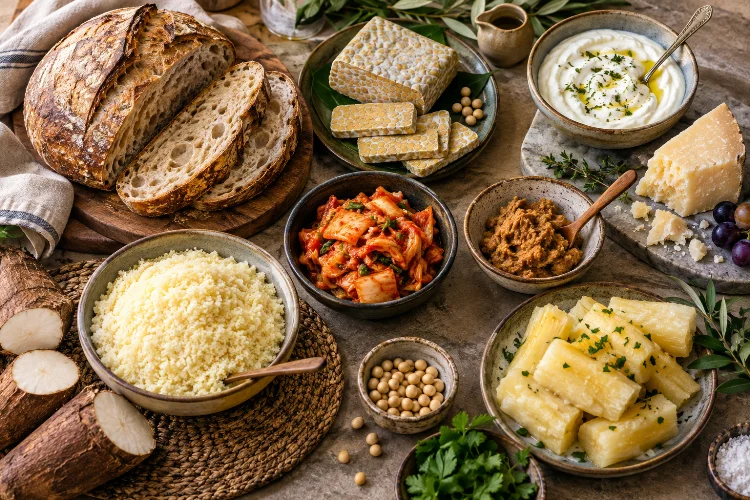
Fermentation is often treated like a modern food trend, but people were relying on it long before anyone understood bacteria, yeasts, or molds.
For many communities, fermented food was not an optional condiment sitting beside dinner. It was dinner.
Grains became sour breads, soybeans turned into protein-rich cakes and pastes, milk developed into yogurt and cheese, while cassava was transformed into more stable foods that could feed households throughout the year.
Exploring fermented staples that define global culinary traditions reveals how deeply fermentation is connected with everyday survival, regional identity, and flavor.
Fermentation can extend shelf life, change texture, create acidity, unlock new aromas, and alter the nutritional properties of raw ingrediants. Different cultures developed their own methods based on available crops, climate, microorganisms, and culinary preferences.
The result is an extraordinary collection of foods that often look completely unrelated but share the same basic idea: let controlled microbial activity transform something ordinary into a staple worth preserving across generations.
Sourdough Turned Grain Fermentation Into Everyday Bread
Sourdough is one of the clearest examples of fermentation becoming part of daily food culture.
Instead of relying only on commercial baker’s yeast, traditional sourdough uses a community of yeasts and lactic acid bacteria living in a mixture of flour and water. These microorganisms produce gases, organic acids, and aromatic compounds while changing the dough’s structure.
The result is more than sourness.
Fermentation contributes to crust aroma, crumb texture, shelf life, and the distinctive flavor differences found between sourdough traditions. Starters also vary according to flour, maintenance routines, temperature, feeding frequency, and microbial ecology.
That explains why sourdough does not taste identical everywhere.
A bakery maintaining the same culture through repeated refreshment effectively keeps a small microbial ecosystem alive. The bread becomes both a food product and a continuing tradition.
Modern ovens may be different, but the fundamental idea is ancient: flour, water, microbes, and patience can turn grain into something more flavorful and useful.
Injera Shows How Fermentation Can Define an Entire Meal
In Ethiopia and Eritrea, fermentation is central to one of the most recognizable staple foods in the region: injera.
Injera is a soft, slightly sour flatbread commonly associated with teff, although other cereals such as sorghum, barley, wheat, or maize can also be used.
Its fermentation traditionally involves lactic acid bacteria and yeasts. Research describes injera as undergoing spontaneous fermentation, with variables such as temperature, pH, grain type, aeration, and microbial composition influencing the final result.
The fermented batter produces much more than flavor.
Gas formation helps create injera’s characteristic porous surface, while acidification contributes its recognizable tang. That texture is especially practical because the bread doubles as part of the eating system itself, scooping up stews, vegetables, legumes, and sauces.
Here, fermentation does not create a side product.
It shapes the foundation of the meal.
Tempeh Transforms Soybeans Into a Completely Different Food
Raw or cooked soybeans and tempeh barely feel like the same ingredient.
Traditional Indonesian tempeh is created primarily through solid-state fermentation using Rhizopus molds. The fungal growth binds soybeans into a firm cake while enzymatic activity changes their chemical and sensory characteristics.
Research describes tempeh as a major traditional Indonesian food, with fermentation improving digestibility and transforming compounds within the soybeans. Different production methods can also create variations in its microbial community.
Flavor changes as well.
Plain soybeans can taste mild and slightly beany, while tempeh develops nutty, mushroom-like, and savory characteristics that become even more pronounced when fried, grilled, braised, or roasted.
The structure also makes tempeh highly adaptable.
It can absorb sauces without completely falling apart, which helps explain why it functions as an everyday protein rather than simply a fermented specialty.
Fermentation has effectively redesigned the soybean.
Kimchi Connects Fermentation With Season and Community
Kimchi is often described simply as fermented vegetables, but that misses much of its cultural importance.
Traditional kimchi preparation uses vegetables combined with seasonings and, in many versions, fermented seafood. Lactic fermentation then gradually produces acidity and additional aromatic complexity.
The Korean tradition of kimjang – making and sharing kimchi – was inscribed by UNESCO on the Representative List of the Intangible Cultural Heritage of Humanity in 2013.
UNESCO describes kimchi as an essential part of Korean meals and kimjang as a practice transmitted through families while reinforcing community cooperation.
Seasonality historically mattered too.
Large quantities could be prepared before winter, allowing vegetables to be preserved while their flavor continued developing.
Fresh kimchi can taste crisp and vegetable-forward. As fermentation progresses, acidity grows, textures shift, and the seasoning becomes increasingly integrated.
It is a perfect example of how preservation, microbial chemistry, and social tradition can exist in the same jar.
Fermented Cassava Became a Major Staple Across Africa
Cassava presents a different challenge from grain or soy.
The root deteriorates relatively quickly after harvest and requires processing before many traditional uses. Across Africa, fermentation became one of the main solutions.
Cassava is transformed into foods such as gari, fufu, agbelima, attiéké, lafun, and other regional staples. A global review of fermented foods documents multiple fermented cassava products across West, Central, and East Africa.
Gari is particularly important.
It is made from fermented cassava mash that is processed into granular, toasted material. Research describes gari as one of the most widely consumed and traded cassava foods in West and Central Africa.
Fermentation contributes sourness and influences aroma, while processing changes texture and storage characteristics.
The diversity is just as important as the basic technique.
Different regions process cassava differently, producing foods suited to local eating patterns. One crop therefore supports an entire family of fermented staples rather than a single standardized product.
Fermented Dairy Turned Perishable Milk Into Lasting Traditions
Milk is nutritious, but fresh milk is also highly perishable.
Fermentation provided pastoral and farming communities with practical ways to transform it.
Yogurt, kefir, cultured milks, sour cream, and numerous cheeses rely on microorganisms that acidify milk and change its proteins, flavor, and texture. Fermented dairy traditions vary according to geography, animal species, microbial cultures, and historical practices.
This produces huge sensory diversity.
One fermented milk may be thick and gently acidic, while another becomes thin, fizzy, intensely sour, or slightly alcoholic. Cheese takes the principle further by combining fermentation with drainage, salting, microbial ripening, and aging.
Again, preservation eventually became preference.
Communities did not continue making fermented milk only because it lasted longer. They developed an attachment to the tastes and textures fermentation created.
A practical food technology became cultural identity.
Fermented Soy Products Show How One Ingredient Can Create Many Traditions
Tempeh is only one branch of the fermented soybean family.
Across Asia, soybeans are transformed into miso, natto, doenjang, soy sauce, fermented black beans, sufu, cheonggukjang, and many other foods.
These products can use very different microorganisms and processing techniques. Some depend heavily on molds, others on bacteria, while many involve multi-stage microbial communities.
A review of fermented soy foods describes traditions stretching across China, Japan, Korea, Indonesia, and other parts of Asia, each producing different textures, aromas, and chemical changes from the same broad raw material.
That makes soy an excellent demonstration of fermentation’s creative potential.
One process produces a sliceable cake like tempeh. Another creates a thick seasoning paste. Another turns soybeans into a dark liquid condiment rich in savory flavor.
The soybean is the starting point.
Microbiology and cultural technique decide where it ends.
Fermentation Preserves Cultural Knowledge as Much as Food
What makes fermented staples especially interesting is that their recipes are rarely just lists of ingredients.
The process matters enormously.
How warm should the mixture be? How much salt should be added? Which container should be used? How long should it ferment? What should it smell like when it is ready?
Those details were traditionally learned by watching experienced people rather than reading thermometers or laboratory measurements.
Kimjang practices are transmitted through families. Sourdough cultures are repeatedly refreshed.
Injera may use fermented material from previous preparation, while countless dairy and grain ferments depend on inherited starter cultures or established household methods.
This means preserving a traditonal fermented food requires preserving technique as well as the recipe.
Replacing every local process with standardized industrial production may reproduce the basic product, but it can also reduce regional variation.
Food heritage often lives in the small differences.
Modern Science Is Rediscovering What Traditional Fermentation Already Achieved
Scientists can now identify microbial species, measure acids, track metabolites, and examine fermentation with genetic tools that traditional cooks never had.
Yet much of the fundamental knowledge already existed in practical form.
Communities knew that temperature mattered, that a successful starter should be kept, that certain vessels worked better, and that fermentation had gone wrong when smell, texture, or appearance changed unexpectedly.
Modern research helps explain these observations.
Studies of sourdough, tempeh, injera, fermented dairy, and cassava show that microbial communities, processing conditions, raw materials, and time all influence the finished product.
The scientific language is new.
The principle is not.
Fermentation remains a partnership between microorganisms and human decision-making – one that has helped shape everyday food on nearly every continent.
Exploring fermented staples that define global culinary traditions reveals just how much ordinary food depends on microbial transformation.
Sourdough turns grain into aromatic bread, injera makes fermentation central to the meal itself, tempeh reshapes soybeans, while kimchi connects preservation with community tradition.
Across Africa, fermented cassava supports essential foods such as gari and fufu, while dairy fermentation has produced countless regional yogurts, cultured milks, and cheeses.
These staples survived because fermentation solved practical problems while creating flavors people came to value.
The next time you eat a fermented food, look beyond its sourness or savory taste.
Explore what people originally fermented, which microbes became involved, and how the technique was passed down. You may find that one everyday food contains centuries of culinary developement.
