
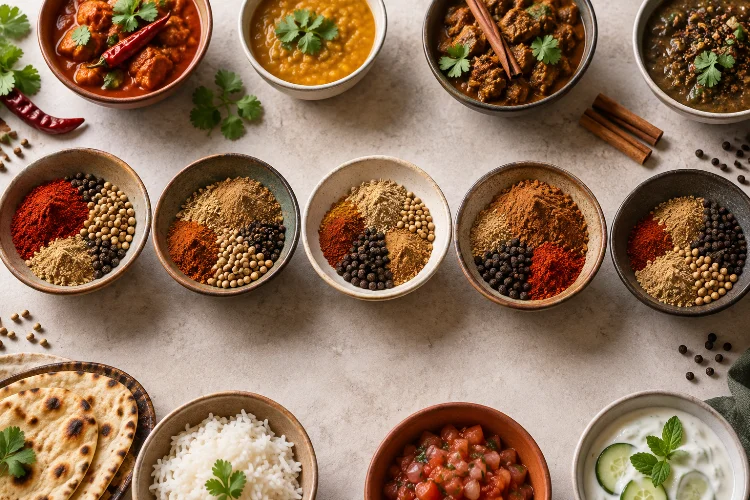
Two kitchens can use cumin, coriander, chile, cinnamon, and black pepper yet produce food that tastes completely different.
The secret is often not the ingredient list. It is the ratio.
One cuisine may make coriander the dominant background flavor while cumin plays a supporting role. Another may push chile forward, reduce the sweeter spices, and rely heavily on pepper for warmth.
Even a tiny adjustment to cloves, cardamom, fenugreek, or cinnamon can shift the personality of an entire dish.
Understanding how regional spice ratios create distinctive culinary identities reveals why simply owning the correct spices does not guarantee an authentic flavor profile.
Regional cuisines are built through repeated relationships between ingredients. Those relationships develop from local agriculture, climate, trade, religious customs, preservation methods, migration, and generations of cooks deciding what tastes balanced.
Recent research examining ingredient networks across world cuisines supports this broader idea: cuisines can develop recognizable “culinary fingerprints” based not only on what ingredients they contain, but on how those ingredients repeatedly appear together.
Spice ratios are one important part of that fingerprint.
Spice Ratios Matter More Than Long Ingredient Lists
A spice blend containing ten ingredients may sound complicated, but complexity does not come from treating all ten equally.
Most successful mixtures have a hierarchy.
One or two spices provide the main character, several support them, and a few intense aromatics appear only in small amounts.
Consider cumin and coriander.
Both appear across South Asian, Middle Eastern, North African, Latin American, and other food traditions. However, changing their proporitions can dramatically change the personality of the seasoning.
A coriander-heavy mixture may feel brighter and slightly citrus-like, while extra cumin creates a deeper, earthier impression.
Now add cloves.
Cloves are powerful enough that even a small increase can make a blend taste noticeably sweeter, warmer, or more medicinal.
Regional seasoning therefore works less like a checklist and more like mixing music. Every instrument may be present, but volume determines what you actually hear.
South Asian Cooking Shows How Ratios Create Regional Differences
South Asian cuisine offers an especially useful example because many familiar spices appear across multiple regions.
Cumin, coriander, turmeric, black pepper, mustard, chile, fenugreek, and asafoetida may all occur in different combinations. Yet their relative importance changes enormously from one preparation to another.
South Indian rasam demonstrates this flexibility.
A review of traditional rasam describes a foundation that can include tamarind, pepper, cumin, coriander, mustard, turmeric, chile, curry leaves, garlic, and other ingredients. Different rasam varieties alter those combinations to create noticeably different results.
Black pepper may dominate one version while cumin stands out more clearly in another.
Those adjustments matter because flavor perception is relational.
Doubling pepper does not simply make the dish “more peppery.” It reduces the relative influence of everything around it.
That is why traditional cooks often adjust seasoning by feel rather than insisting on one universal masala formula.
The identity exists in the relationship between ingrediants.
North African Blends Show Why Fixed Recipes Are Not Always Necessary
Regional spice identity does not always require standardized measurements.
Ras el hanout is a perfect example.
The North African spice mixture does not have one universally accepted recipe. Versions can include pepper, coriander, cumin, cinnamon, ginger, cloves, allspice, chile, and other aromatics in changing proportions.
That variation does not make ras el hanout meaningless.
Instead, it shows how culinary identity can exist within a flexible range.
One merchant or household may emphasize warm sweet spices. Another may create a sharper, pepperier mixture. A third might lean more heavily on coriander and cumin.
The overall structure still feels connected to a recognizable tradition.
This is an important lesson when discussing authenticity.
Traditional cuisine is often less like a laboratory formula and more like a language. Speakers can form different sentences while remaining recognizably within the same language.
Spice ratios provide the accent.
Heat Is Relative to the Rest of the Blend
Chile is one of the clearest demonstrations of how ratio changes perception.
A seasoning mix containing chile is not automatically “hot.” Its intensity depends on the type of chile, the amount used, and what surrounds it.
Tunisia’s harissa illustrates how chile can become the dominant flavor foundation rather than a background accent.
UNESCO describes traditional Tunisian harissa as a chile-pepper preparation seasoned with ingredients including garlic, salt, and coriander. It is deeply embedded in daily food traditions and household culinary practices.
That relationship is very different from a blend where dried chile represents only a small percentage of the total mixture.
Even within hot cuisines, chile intensity varies according to dish.
Fat can soften the perception of capsaicin. Acidity can create brightness around heat, while sweetness can change how aggressively the spice is perceived.
So a regional spice ratio should never be interpreted independently from the rest of the food.
The same teaspoon of chile can feel moderate in a rich coconut sauce and extremely aggressive in a light broth.
Small Quantities of Powerful Spices Define Regional Character
Some seasonings create identity precisely because they are used sparingly.
Cloves, star anise, cardamom, mace, nutmeg, and fenugreek are good examples.
Increase their quantity slightly and the entire aromatic balance can shift.
Chinese five-spice illustrates this principle conceptually. Star anise often provides an instantly recognizable sweet, licorice-like aroma, yet it works alongside other warming components rather than functioning alone.
The exact composition varies, just as traditional spice formulas often do.
This is why copying a regional blend by volume can sometimes fail.
One tablespoon each of five different spices does not produce balance simply because the measurements are equal.
A better approach is to consider aromatic strength.
Strong spices may need a fraction of the amount used for mild foundation seasonings.
Traditional cooks frequently learn this relationship through repetition rather than measurement. A grandmother may say “just a little clove” because generations of experiance have already established that too much would overpower everything else.
Trade Expanded Regional Spice Palettes but Did Not Standardize Them
Many regional cuisines would look very different without centuries of spice trade.
UNESCO describes the Silk Roads as interconnected land and maritime networks through which spices, cereals, fruits, vegetables, technologies, and cultural knowledge moved across Eurasia.
Maritime sections were particularly important for spices and became known as spice routes.
Indonesia played a particularly important role.
Historic trade routes connected spice-producing regions such as Maluku with merchants from China, South Asia, the Middle East, North Africa, and eventually Europe.
But trade did not make every cuisine taste identical.
Quite the opposite.
When spices arrived in new regions, local cooks incorporated them into existing food systems. An imported aromatic might be paired with local fats, vegetables, grains, fermentation products, or proteins.
The amount used was determined by local preference.
So trade supplied ingredients, but communities decided their ratios.
That process explains how the same spice could become central to one cuisine, occasional in another, and almost absent from a neighboring food tradition.
Regional Identity Comes From Repeated Flavor Relationships
Modern data analysis provides an interesting way to see this principle.
A 2025 npj Science of Food study analyzed 45,661 recipes across 23 cuisines and found that cuisines have distinctive patterns in the way ingredient categories are combined.
Indian cuisine, for example, showed an especially prominent role for spices within its ingredient network.
Earlier research also found that global cuisines do not necessarily follow the same flavor-pairing strategy.
A 2011 Scientific Reports study analyzing more than 56,000 recipes found differences between Western and East Asian ingredient-combination patterns.
Western cuisines showed a greater tendency to pair ingredients sharing flavor compounds, while East Asian recipes more frequently combined ingredients sharing fewer compounds.
Neither finding creates a universal rule for seasoning.
Instead, they demonstrate something more useful: culinary cultures develop patterned preferences.
Spice ratios belong inside those patterns.
Repeated choices about how much cumin, pepper, chile, coriander, cinnamon, mustard, or ginger to use eventually become part of the sensory identity people associate with a place.
Cooking Technique Can Change the Effective Ratio
Written measurements tell only half the story.
A teaspoon of cumin added raw does not taste exactly like a teaspoon of cumin toasted before grinding.
Likewise, spices fried in fat at the beginning of cooking behave differently from seasonings sprinkled over food just before serving.
That means a recipe’s effective spice ratio depends partly on technique.
Suppose two dishes contain identical quantities of cumin, coriander, and cardamom.
In the first, all three simmer for an hour. In the second, cumin and coriander cook slowly while freshly ground cardamom is added at the end.
The second dish may taste far more strongly of cardamom even though the measurements are identical.
Grinding size also changes perception.
Finely ground pepper disperses quickly, while cracked pepper creates occasional bursts of pungency. Whole spices release aromatic compounds more slowly.
This is why traditional seasoning cannot be reduced to percentages alone.
Ratio, timing, temperature, and physical form work together.
Home Cooks Can Learn Regional Flavor by Adjusting Ratios
The easiest way to understand regional seasoning is through comparison.
Instead of starting with ten spices, choose three or four.
For example, combine coriander, cumin, black pepper, and a small amount of cinnamon. Make three tiny batches while changing only the ratio of coriander to cumin.
Smell them separetely.
Then toast each mixture briefly and smell them again.
The difference becomes much easier to understand than it would be from reading a spice list.
You can apply the same experiment to chile and pepper, cumin and fennel, or cinnamon and cloves.
The goal is not to invent an “authentic” regional recipe from scratch.
It is to train your palate to recognize hierarchy.
Once you understand which spice forms the foundation, which creates the middle layer, and which provides the aromatic highlight, complex regional seasoning becomes much easier to decode.
Understanding how regional spice ratios create distinctive culinary identities shows why flavor is about relationships rather than simply ingredients.
Cumin, coriander, chile, pepper, cinnamon, mustard, and other spices travel widely, yet cuisines use them in very different proportions.
Those ratios are shaped by local tastes, available ingredients, trade, cooking techniques, and generations of accumulated knowledge.
Modern research suggests that cuisines develop recognizable ingredient-combination fingerprints, while traditional dishes show how subtle ratio adjustments can create major sensory differences.
Next time you cook with a regional spice blend, do not only ask which seasonings are present.
Ask which one leads, which ones support it, and which appear only as accents. Understanding those relationships is one of the easiest ways to understand the culinary identity behind the dish.
