
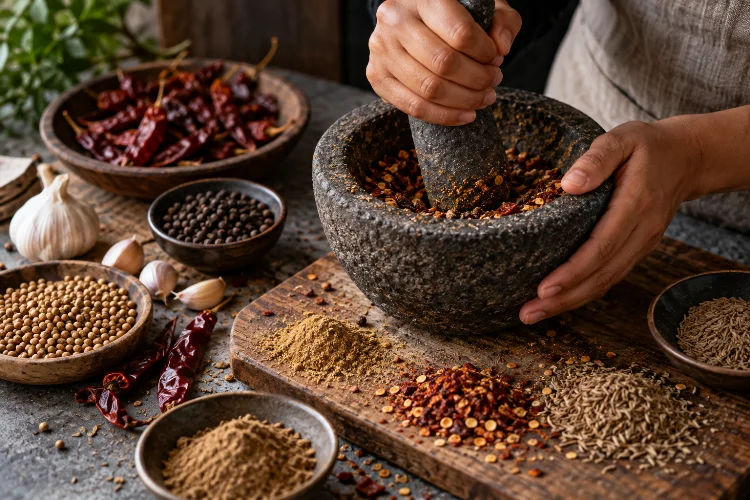
Take the same coriander seeds, peppercorns, dried chiles, cumin, and garlic, then process them in two different ways. Pound one batch slowly in a mortar and pulverize the other in a high-speed grinder.
Even with identical ingredients, the finished seasoning may smell, feel, and behave differently. That difference is easy to underestimate.
Understanding why grinding method matters in complex traditional seasoning mixes means looking at particle size, friction, temperature, exposed surface area, volatile oils, and texture.
Grinding is not simply a convenient way to make large ingredients smaller. It changes how quickly flavor compounds escape and how seasonings interact with fat, water, and food.
Traditional kitchens developed tools such as stone mortars, metates, hand mills, and wooden pestles long before electric appliances existed. Those tools produced characteristic textures that became part of particular recipes.
Modern machines are faster and incredibly useful, but speed can alter the process. Sometimes the finest powder is ideal. In other dishes, a rough, uneven grind creates exactly the complexity the cook wants.
Grinding Releases Aroma by Breaking the Spice Structure
Whole spices naturally protect much of their aroma inside plant tissues.
Crack a peppercorn or coriander seed and you immediately notice a stronger smell because the grinding process breaks cellular structures and exposes aromatic oils to the air.
That is the basic purpose of grinding.
The smaller the particles become, the larger their total exposed surface area. This allows aromatic and taste compounds to interact more rapidly with cooking oil, water, meat, vegetables, or broth.
A recent study comparing processing methods for cinnamon and star anise found that smaller particle sizes could accelerate flavor release and affect characteristics such as solubility.
But faster release is not always better.
Finely ground spices can deliver a large portion of their flavor very quickly. Coarsely crushed spices release aroma more gradually, which can create a longer, more layered effect during cooking.
The ideal grind therefore depends on what the seasoning needs to do.
Particle Size Changes How Flavor Develops in the Dish
Imagine black pepper in three forms: whole peppercorns, roughly cracked pepper, and fine powder.
They are chemically related, but they behave very differently in food.
Whole peppercorns release flavor gradually into soups and braises. Cracked pepper creates occasional intense bursts, while fine powder spreads pungency almost everywhere.
Traditional seasoning mixes use this difference strategically.
A coarse mixture may allow individual coriander, chile, cumin, and pepper fragments to remain noticeable. Finely grinding the same ingrediants produces a more uniform flavor because the particles become thoroughly distributed.
Research on black pepper confirms that grinding conditions affect particle size, surface area, surface structure, and physicochemical properties.
Texture is therefore part of flavor architecture.
A seasoning does not need to dissolve into complete uniformity to taste complex. Sometimes the variation between one bite and the next is exactly what makes traditional food interesting.
High-Speed Grinding Can Generate Heat
Electric grinders save enormous amounts of time, but their speed creates another variable: heat.
Mechanical energy used to fracture hard spices creates friction. In intensive grinding systems, temperatures can rise enough to affect heat-sensitive aromatic compounds.
A review of domestic mixer-grinder processing notes that spices are ground to release flavor, but increasing temperature during processing and storage can reduce quality.
Black pepper research provides an especially clear example.
One pilot-scale study comparing conventional and cryogenic grinding found that ambient grinding resulted in roughly 50% greater loss of volatile oil relative to cryogenic processing.
Low-temperature grinding preserved more monoterpenes and produced stronger sensory “top notes” associated with freshness.
This does not mean your home grinder automatically destroys half the flavor every time you use it. Industrial grinding conditions are different.
The practical lesson is simpler: avoid unnecessarily prolonged grinding.
Short pulses can reduce heat buildup, and allowing equipment to cool between large batches can help protect delicate aromas.
Mortar and Pestle Grinding Creates a Different Texture
Traditional pounding is much slower than pressing a button, but speed is not its only difference.
A mortar and pestle combines crushing, shearing, and grinding pressure. Instead of immediately reducing everything to a uniform powder, the cook can stop at almost any desired texture.
That control is valuable in seasoning pastes.
UNESCO’s description of traditional Tunisian harissa, for example, notes that dried chile peppers are ground and seasoned with salt, garlic, and coriander using tools including a pestle and mortar.
Indonesian sambal offers another familiar example.
Research on the diversity of Indonesian sambals describes traditional stone mortar-and-pestle preparation alongside modern blender processing.
Many sambals depend on crushing chiles, garlic, shallots, tomatoes, and other components into a paste rather than a perfectly smooth puree.
That imperfect texture can be desirable.
Small pieces of chile, garlic, spice, or shallot continue releasing flavor while the food is eaten. A completely homogenized mixture creates a differnt sensory experience.
Neither approach is automatically superior—they simply produce different results.
Traditional Grinding Tools Are Part of Culinary Identity
Grinding methods often survive because they are tied to much more than efficiency.
They belong to culinary traditions.
Traditional Mexican cuisine provides a strong example. UNESCO specifically identifies grinding stones and stone mortars among the distinctive utensils associated with ancestral Mexican culinary practices.
These tools are connected with preparations involving maize, chiles, cacao, tomatoes, and countless sauces.
Changing the tool can sometimes change the texture enough to change how a familiar dish is perceived.
This helps explain why experienced cooks may insist that a particular salsa, spice paste, or seasoning tastes different when made traditionally. The distinction is not necessarily mysterious or romantic.
A stone surface, hand pressure, processing speed, particle size, and grinding sequence can all affect the final preparation.
Traditional knowledge includes knowing not only what to grind, but also how far to grind it.
Grinding Temperature Matters for Volatile Oil Retention
The importance of temperature becomes even clearer when researchers deliberately grind spices under very cold conditions.
Cryogenic grinding uses extremely low temperatures, often involving liquid nitrogen, to limit heat generation and retain volatile compounds.
Studies on cumin found that increasing grinding temperature in the ambient range significantly reduced volatile oil content, while much lower cryogenic temperatures better protected major aroma compounds such as cuminaldehyde and several terpenes.
Similar results appear with black pepper.
Research comparing hammer milling with cryogenic grinding found that low-temperature processing caused less damage to flavor, color, and sensory characteristics.
Home cooks obviously do not need liquid nitrogen to prepare garam masala.
The research is useful because it demonstrates the underlying principle: aroma molecules can be sensitive to the conditions under which grinding occurs.
That is another reason freshly ground spices usually seem more expressive than powders that have been repeatedly heated, processed, transported, and stored.
Coarse and Fine Grinding Serve Different Culinary Purposes
There is no universally perfect particle size for a spice blend.
Fine powders are valuable when the seasoning needs to coat food evenly. A smooth rub can cover meat consistently, while finely ground spices disperse easily through sauces and curries.
Coarse mixtures do something different.
They provide bursts of aroma and texture. They also release compounds more gradually during long cooking.
That makes coarse grinding particularly useful for braises, marinades, pickles, crusts, and seasoning mixtures where individual components should remain detectable.
A cook can even combine both.
Imagine a mixture with finely ground cumin and coriander creating the background flavor, alongside cracked pepper and crushed chile delivering sharper aromatic moments.
This builds several levels of intensity from the same seasoning.
Modern food research supports the basic mechanism behind this strategy: particle reduction changes surface area, solubility, and the speed at which compounds are released into food.
Grinding size is therefore another seasoning tool, just like salt level or cooking time.
Grinding Ingredients Separately Gives Better Control
Complex traditional blends often contain ingredients with very different structures.
A dried chile is not physically similar to a peppercorn. Cinnamon bark behaves differently from cumin seed, while cloves are harder and more intensely aromatic than coriander.
Grinding everything together can be convenient, but seperate processing sometimes gives better control.
Hard spices can be crushed first. Softer ingredients can follow later. Extremely powerful spices can remain slightly coarser or be used in smaller amounts.
The order matters even more in wet pastes.
Garlic, ginger, lemongrass, fresh chile, dry spices, nuts, salt, and fermented ingredients contain different levels of moisture and fiber. Adding them gradually allows the cook to control how the paste develops.
This is partly why traditional mortar techniques often feel slow.
The cook is building structure rather than merely reducing size.
The process also allows constant adjustment. You can smell the mixture, feel its texture, and decide whether another minute of grinding will improve it or simply make it smoother than necessary.
Fresh Grinding Changes Storage Life Too
Breaking a spice apart creates aroma, but it also starts a countdown.
Once spices are ground, more surface area is exposed to oxygen, moisture, and light. Volatile compounds can evaporate more easily and oxidation can gradually change the aroma.
Whole spices generally protect their flavor better during storage.
This is why grinding smaller quantities shortly before cooking can produce noticeably fresher seasoning than keeping large batches of powder for months.
The effect is particularly obvious with pepper.
Research into cryogenic and ambient grinding shows how strongly processing conditions influence volatile-oil retention and fresh aromatic notes.
For everyday cooking, you do not need special equipment.
Keep whole spices when practical, store them away from heat and light, and grind only what you expect to use within a reasonable period.
The extra preperation takes minutes, but the sensory difference can be significant.
Understanding why grinding method matters in complex traditional seasoning mixes reveals that grinding is not just a mechanical preparation step.
Particle size determines how quickly flavor is released. High-speed processing can generate heat, while different crushing methods create different textures.
Fine powders produce even distribution, whereas coarse spices provide gradual release and occasional bursts of intensity.
Traditional mortars, grinding stones, and hand mills survived partly because cooks learned exactly what textures those tools could create. Modern grinders offer tremendous convenience, but the best method still depends on the dish.
Try a simple comparison at home. Grind one small spice batch finely and crush another coarsely, then use them in the same basic recipe.
Pay attention to aroma, texture, and when each flavor appears – you may discover that grinding is as important as the seasoning itself.
