
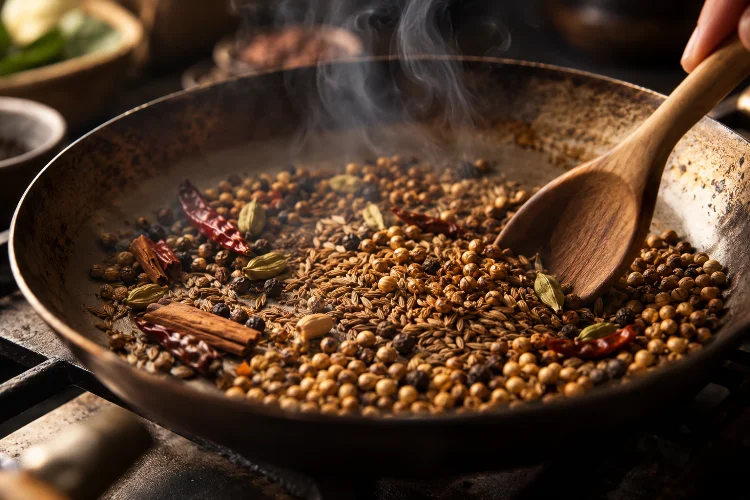
A spoonful of raw cumin smells earthy and sharp. Toast those same seeds for a minute or two, and suddenly the aroma becomes warmer, nuttier, and noticeably deeper.
Nothing new has been added, yet the spice seems almost transformed. That small kitchen ritual reveals a surprising amount of food chemistry.
Understanding how toasting changes the chemistry of traditional spice blends means looking at volatile oils, heat-driven reactions, moisture loss, oxidation, and the formation of new aromatic compounds.
Traditional cooks discovered these effects through experience long before laboratories could identify individual flavor molecules.
Across South Asia, the Middle East, North Africa, and other spice-rich culinary regions, heating whole spices before grinding became an important way to build depth.
But toasting is not simply about making spices “stronger.” Heat can enhance certain aromas while destroying others. Some compounds become more noticeable, while delicate volatile molecules evaporate or break down.
The secret is controlling that transformation before pleasant roasted complexity turns into bitterness.
Raw Spices Contain Complex Aromatic Chemistry
Whole spices may look dry and inactive, but chemically they are packed with aromatic compounds.
Cumin contains compounds including cuminaldehyde and various terpenes. Coriander is strongly associated with linalool, while fennel and anise contain compounds responsible for their characteristic sweet, licorice-like aromas.
These compounds are volatile.
That means they can evaporate relatively easily and reach the nose, which is why crushing a coriander seed immediately releases more aroma than simply holding the intact seed.
Research examining anise, caraway, coriander, cumin, and fennel identified 117 volatile compounds across these spices. Oxygenated monoterpenes represented a major part of the volatile profile in their raw state.
Toasting changes this chemical starting point.
Heat can release trapped aromatic compounds, transform existing molecules, and create entirely new ones.
This is why toasted spices do not merely smell like warmer versions of raw spices.
They can have a genuinely different chemical profile.
Heat Releases Volatile Oils – but Can Also Drive Them Away
One of the first things you notice when spices hit a warm pan is the smell.
Heat increases molecular movement and encourages volatile compounds to escape from the spice into the surrounding air. That initial burst of aroma is part of what makes dry-toasting so satisfying.
But there is a catch.
The fragrance filling your kitchen is also fragrance leaving the spice.
Extended heating can reduce some delicate volatile compounds rather than intensify them indefinitely. Research on black cumin, for example, found that roasting decreased levels of important compounds such as thymoquinone while changing the overall volatile profile.
This explains why gentle toasting and aggressive roasting produce very different results.
A brief warming may release aroma without destroying too much of the original character. Longer heating pushes the spice toward a more roasted profile while reducing some fresh, floral, or herbal notes.
Good spice toasting is therefore a trade-off.
You are intentionally losing certain aromas to gain others.
New Roasted Aromas Form Through Heat-Driven Reactions
Perhaps the most interesting effect of toasting is that heat can create compounds that were barely present – or not present at all – in the raw spice.
Research on roasted anise, caraway, coriander, cumin, and fennel found newly detected compounds including pyrazines and other heat-generated aroma molecules after roasting.
Pyrazines are especially important.
They are often associated with roasted, nutty, toasted, and sometimes earthy aromas. Similar families of compounds appear in roasted coffee, toasted nuts, cooked meat, and baked foods.
Black cumin provides a clear example.
Scientists found that roasting significantly increased pyrazines and furans in the seeds, helping explain the sensory difference between raw and roasted black cumin.
So when toasted spices start smelling nuttier, the effect is not simply psychological.
Their chemistry is actually changing.
The Maillard Reaction Can Add Another Layer of Complexity
The Maillard reaction is famous for creating the browned flavor of bread crust, roasted coffee, seared meat, and many other cooked foods.
It occurs when certain carbonyl compounds, including reducing sugars, interact with amino compounds under suitable heating conditions. The reaction can eventually generate a huge range of aroma-active molecules.
Spices contain only limited amounts of the ingredients involved compared with foods such as bread or meat, so Maillard chemistry varies significantly between spices.
Still, roasting can generate Maillard-type volatile compounds.
Research on roasted umbelliferous spices identified new pyrazines and other compounds linked with heating, while newer work on black pepper similarly describes roasting as triggering reactions that contribute to distinctive aroma formation.
Temperature is critical.
Maillard reactions generally accelerate as temperatures rise, but excessively high heat can also cause burning, bitterness, and destruction of desirable aromas.
That is why “hotter” does not automatically mean “better.”
Different Spices Respond to Toasting in Different Ways
One of the easiest mistakes is to toast every spice for exactly the same amount of time.
Their chemistry is different, so their reactions are different too.
A study comparing roasted anise, caraway, coriander, cumin, and fennel found noticeably different responses among the spices. Cumin showed an increase in cuminaldehyde under roasting conditions, while fennel showed a decrease in estragole.
This explains something traditional cooks have understood for generations.
Some spices become dramatically richer after toasting, while others lose the delicate characteristics that make them appealing.
Cumin generally responds well to moderate roasting because deeper toasted notes complement its naturally earthy aroma. Coriander can become warmer and nuttier while maintaining some citrus-like character.
Delicate aromatic spices may require much shorter heating.
This is why many experienced cooks toast spices seperately when precision matters. A large coriander seed and a tiny clove do not necessarily reach their ideal aromatic state at the same moment.
Moisture Loss Concentrates the Sensory Experience
Spices contain relatively little water compared with fresh food, but they are not completely moisture-free.
Heating removes part of that remaining moisture.
As water evaporates, the physical structure of the spice changes. Seeds can become more brittle, making them easier to grind and helping produce a finer, more evenly distributed powder.
That can change flavor perception.
A freshly toasted spice blend that has been finely ground exposes more surface area than intact seeds. More aromatic material can interact with cooking fat, broth, meat, or vegetables.
The result may seem more intense even when the amount of spice has not changed.
This is one reason the traditional sequence matters:
Toast first, cool briefly, then grind.
Grinding before roasting exposes far more surface area directly to heat, making delicate compounds easier to lose and finely powdered spices easier to burn.
Technique protects chemistry.
Toasting Can Increase Oxidation as Well as Aroma
Not every chemical change caused by heat is desirable.
Spices contain oils, and heating can encourage oxidation of some lipid components.
Researchers examining several roasted spices measured peroxide values as an indicator of oxidation. Roasted cumin showed a higher peroxide value than the other tested spices, although the levels reported in that study were not considered a health hazard.
The practical lesson is more about flavor than danger.
Overheated oils can contribute stale, harsh, or unpleasant notes. Toasting should therefore stop once the desired aromatic transformation has occurred.
The pan’s residual heat matters as well.
Leaving spices sitting in a very hot skillet after turning off the burner can continue cooking them.
Experienced cooks often transfer toasted spices immediately to a plate or bowl.
That small step prevents aromatic complexity from becoming burnt bitterness.
Toasting Before Grinding Changes the Structure of a Spice Blend
Traditional spice blends are not defined only by which ingredients they contain.
Processing order matters too.
Suppose cumin, coriander, pepper, and cloves are combined raw and ground together. The resulting mixture preserves more of their fresh volatile characteristics.
Toast those spices first and the blend develops a different profile.
Roasted compounds appear, some raw volatiles decrease, moisture drops, and grinding releases newly formed aromas.
Research on cumin confirms that conventional roasting can substantially alter the chemical composition of its volatile fraction.
This means two spice blends containing exactly the same measurements can taste noticeably different simply because one was toasted.
That difference is part of traditional culinary architecture.
Recipes are not only formulas of ingrediants. They are sequences of chemical transformations.
Why Medium Heat Usually Gives Better Control
For home cooks, toasting spices should usually be more controlled than dramatic.
A screaming-hot pan may produce aroma quickly, but it also creates a narrow window between toasted and burned.
Moderate heat gives you time to observe the changes.
Watch for slightly deeper color, listen for subtle crackling, and pay attention to the moment the aroma becomes noticeably stronger. Continuous movement helps reduce hot spots.
The nose is particularly useful.
If cumin smells warm, nutty, and fragrant, it is probably approaching the useful zone. If smoke appears and the smell becomes acrid, you have likely pushed it too far.
Research on black pepper processing similarly notes that uncontrolled temperatures and excessive roasting can produce darkening, burnt flavors, and bitter taste.
Traditional cooks did not need chemical instruments to recognize this boundary.
Their sensory judgement effectively served as quality control.
Toasted and Untoasted Spices Can Work Together
One clever way to create deeper spice architecture is not to choose between toasted and raw spices at all.
Use both.
Toasted cumin can provide roasted depth, while a smaller amount of freshly ground cumin added later restores some of the brighter volatile notes lost during heating.
The same principle can work with coriander or certain spice blends.
This creates several aromatic layers rather than one uniform profile.
Traditional cooking often follows a similar logic by adding spices at multiple points: whole spices in hot fat at the beginning, ground spices during cooking, and fresh aromatic mixtures near the end.
Chemically, each stage preserves or generates a different group of compounds.
The finished dish therefore has more depth because its spices have experienced different thermal histories.
That sounds technical, but cooks have been doing it intuitively for centuries.
Understanding how toasting changes the chemistry of traditional spice blends shows why such a simple technique can dramatically alter flavor.
Heat releases volatile oils while causing some delicate compounds to disappear. At the same time, roasting generates new aromatic molecules such as pyrazines and can trigger Maillard-type reactions that create nutty, earthy, and toasted notes.
Moisture loss changes grinding behavior, while excessive heat encourages oxidation and bitterness. The key is control rather than maximum roasting.
Next time you make a spice blend, compare a small portion raw with the same mixture gently toasted.
Smell and taste them side by side. That simple experiment makes the chemistry remarkably easy to understand – and may completely change how you approach spice preperation.
