
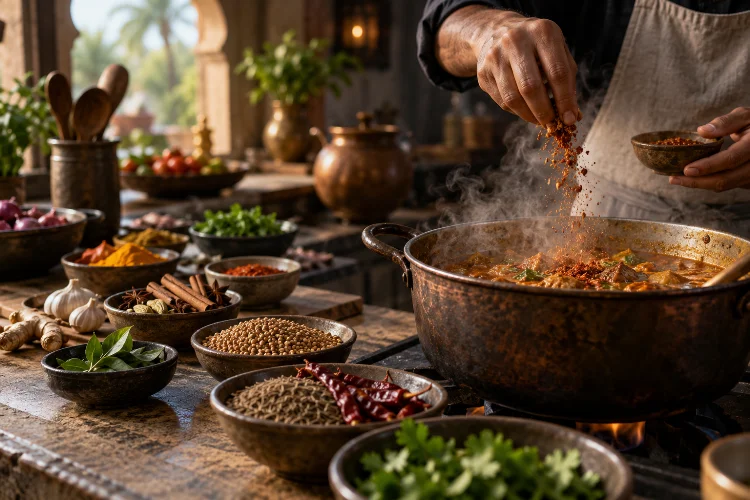
A great spiced dish rarely tastes like someone simply emptied a spice cabinet into the pot.
Instead, the flavors seem to arrive in stages. You might notice warm cumin first, then citrus-like coriander, a little chile heat, something sweet in the background, and finally a fragrant note that stays after the bite is gone.
That effect is what we can think of as layered spice architecture in regional cooking. Rather than treating spices as interchangeable seasonings, traditional cuisines give different ingredients specific roles.
Some form the base, others provide heat or bitterness, and a few are reserved for the final aromatic lift. The order matters just as much as the ingredients themselves.
Regional cooks developed these systems through generations of experimentation, local agriculture, trade, migration, and sensory knowledge.
Modern research also shows that cuisines develop recognizable ingredient-combination patterns rather than following one universal formula for flavor pairing.
Once you start thinking about spices as layers instead of a list, complex regional cooking becomes much easier to understand.
Spice Architecture Starts With a Flavor Foundation
Every well-structured spice profile needs a foundation.
These base spices usually provide warmth, earthiness, or gentle aroma without immediately dominating the dish. Cumin, coriander seed, turmeric, mild chile, black pepper, or mustard seed can play this role depending on the cuisine.
Their purpose is similar to the bass line in music. You may not consciously focus on it, but everything else feels less complete when it disappears.
South Indian rasam demonstrates how this works.
Traditional rasam commonly combines tamarind with spices such as cumin, black pepper, coriander, mustard, turmeric, chile, and other aromatics. Different versions alter both the ingredients and their proportions, creating recognizable variations from the same general structure.
That flexibility is important.
Spice architecture does not mean every recipe follows an exact mathematical ratio. It means each ingredent has a purpose within a broader flavor system.
Middle Notes Create the Character of a Dish
Once the base is established, the next layer gives the food personality.
These middle notes may include ginger, garlic, cinnamon, fennel, cardamom, fenugreek, paprika, or dried chile. They are usually more noticeable than the foundation but still need to integrate with the main ingredients.
This is where regional identity becomes obvious.
Two cuisines might both use cumin and coriander, yet one may combine them with cinnamon and dried fruit while another uses mustard seeds, curry leaves, chile, and tamarind.
Research into regional Indian cooking has found distinct geographical patterns in how spices are used. A recent analysis covering 18 Indian regional cuisines showed meaningful differences in spice frequencies, including a recognizable north-to-south pattern.
That helps explain why simply owning the same spices does not automatically produce the same cuisine.
The architecture comes from relationships between them.
Powerful Spices Work Best as Top Notes
Some spices are simply louder than others.
Cloves, star anise, mace, nutmeg, green cardamom, and certain types of chile can dominate a dish quickly. Traditional cooks often use them in smaller quantities or introduce them strategically.
Think of these as top notes.
Their job is to make the flavor more interesting rather than carry the entire dish.
A single clove may disappear into a large pot of stew while still adding a subtle aromatic warmth. Use several too many, and suddenly everything tastes like clove.
This principle is especially important when learning unfamiliar regional cooking.
Recipes containing eight or ten spices do not necessarily use equal quantities of each one. A tablespoon of coriander and a tiny pinch of clove can have equally important roles despite the huge difference in volume.
Good spice architecture depends on impact, not equal measurement.
Timing Determines Which Layer You Actually Taste
When you add a spice can matter almost as much as how much you add.
Whole spices heated in oil near the beginning of cooking create one effect. Ground spices simmered in a sauce produce another. Freshly ground aromatic spices sprinkled near the end create something different again.
Traditional South Asian cooking frequently uses this principle.
Seeds such as mustard or cumin may be heated in fat first, allowing their aromas to spread through the oil. Ground spices can then form part of the main sauce, while finishing mixtures provide a fresh aromatic layer before serving.
If every spice enters at the beginning, delicate aromas may disappear during prolonged cooking.
If everything is added at the end, the spices may taste raw and disconnected.
Layered preperation avoids both problems.
Some flavors become deep and mellow. Others remain bright and obvious.
That contrast is what gives a finished dish depth.
Heat Changes the Personality of Spices
Temperature also changes spice architecture.
Toasting coriander seeds can intensify their warm, nutty qualities. Heating cumin brings out deeper roasted aromas. Mustard seeds become noticeably different once they begin popping in hot oil.
But more heat is not always better.
Burned spices can introduce harsh bitterness, and finely ground powders can scorch surprisingly quickly.
This is why experienced cooks pay attention to the form of the spice.
Whole seeds tolerate heat differently from powders. Aromatic spices containing delicate volatile compounds may benefit from shorter exposure, while sturdy seeds can often handle stronger roasting.
Heat therefore acts like an editing tool.
The cook can push one flavor forward, soften another, or completely ruin the balence by taking the temperature too far.
That is one reason traditional spice cooking often involves several stages rather than one intense blast of heat.
Fat and Liquid Decide Where Aromas Travel
Spices do not exist in isolation once they enter a dish.
Their aromatic compounds interact with water, fat, alcohol, acids, and other ingredients.
Many spice aromas disperse particularly effectively through cooking fats, which helps explain why oil, butter, ghee, coconut milk, and animal fats play such important roles in heavily spiced cuisines.
A spice heated briefly in oil can perfume the entire dish.
Meanwhile, water-based cooking extracts and distributes other components differently. This is why a spice mixture used in a dry roast can taste noticeably different from the same combination simmered in broth.
The amount of fat matters too.
A rich coconut curry can absorb a fairly assertive spice profile without feeling overwhelming, while the same quantity might dominate a light vegetable soup.
Acid changes perception as well.
Tamarind, citrus, vinegar, yogurt, or tomato can brighten spices and make heavy flavors feel fresher.
Spice balance therefore depends on the entire recipe, not just the spice jar.
Regional Spice Systems Grew Through Trade and Cultural Exchange
Many traditional spice combinations would not exist without long-distance trade.
UNESCO describes the Silk Roads as extensive land and maritime networks connecting societies across Eurasia. Spices were important enough within maritime commerce that some routes became known specifically as the spice routes.
Trade expanded the number of flavors available to regional cooks.
Medieval Arab cuisine, for example, benefited from commercial connections across the Mediterranean, Indian Ocean, and Silk Roads.
Ingredients such as cinnamon, nutmeg, cloves, saffron, rice, pistachios, and other products moved between regions and entered increasingly complex culinary systems.
Southeast Asia was equally important.
Indonesia’s historic spice routes connected producing regions such as Maluku with merchants from Asia, the Middle East, North Africa, and eventually Europe.
But importing a spice did not automatically create a regional cuisine.
Local cooks still had to decide what to combine it with, how much to use, and when it should enter the dish.
Trade supplied the vocabulary. Regional cooking wrote the sentences.
Contrast Can Be More Important Than Similarity
It is tempting to assume that ingredients taste good together because they share similar aromatic compounds.
Sometimes they do.
However, research comparing thousands of recipes has shown that different cuisines can follow very different pairing patterns.
A major Scientific Reports study found that North American and Western European recipes tended to combine ingredients sharing more flavor compounds, while East Asian cuisines showed a tendency toward combinations sharing fewer.
That tells us something important about spice architecture.
Complex flavor does not always come from similarity.
Contrast can be equally valuable.
Sweet spices can sit beside chile heat. Bitter fenugreek can work against rich fats. Acidic ingredients can sharpen earthy cumin, while fresh herbs can lighten deeply roasted spice mixtures.
Regional traditions develop their own ideas about how much contrast feels pleasant.
There is no single scientific formula for the perfect spice blend.
Culture matters enormously.
Layering Prevents Complex Spice Blends From Becoming Muddy
One of the biggest dangers in spice-heavy cooking is what might be called flavor mud.
Everything is technically present, but nothing is clear.
This often happens when too many ground spices are added in similar quantities at the same stage. Rather than tasting complex, the dish becomes generically “spiced.”
Layering solves that problem by creating separation.
Whole spices might perfume the cooking fat. A paste of aromatics provides the second layer. Ground spices build the body, while fresh herbs or a finishing spice mixture add the final lift.
Texture can create separation as well.
A whole cardamom pod releases aroma slowly, while ground cardamom appears immediately. Whole black pepper produces occasional bursts of intensity that finely ground pepper cannot reproduce.
Traditional cooks often combine multiple forms of seasoning for precisely this reason.
The flavor does not arrive all at once.
It unfolds.
Learning Spice Architecture Is Better Than Memorizing Blends
Memorizing a famous spice blend can be useful, but understanding its structure is more flexible.
Ask what each spice is doing.
Which ingredient creates the earthy base? Which one contributes sweetness? Where does the heat come from? Is there bitterness? Which spice provides the strongest aroma?
Then look at timing.
Which seasonings are toasted, which simmer, and which appear near the end?
This approach makes regional recipes easier to adapt without losing their basic character.
If one spice is unavailable, you can think about its role rather than grabbing a random replacement. If the dish tastes too heavy, you may need acidity or fresh aromatics rather than simply reducing every seasoning.
Even traditional recipes evolve this way.
Cuisines are living systems built through generations of experimentation, not frozen formulas that must always be copied seperately from context.
Understanding layered spice architecture in regional cooking reveals why complex dishes can contain numerous seasonings without becoming overwhelming.
Successful spice systems usually have structure. Foundation spices create depth, middle notes establish regional character, and powerful aromatics provide highlights. Timing, heat, fat, acidity, and grinding size then determine how clearly those layers appear.
History matters too. Trade routes expanded regional spice vocabularies, while local communities transformed imported ingredients into distinctive culinary traditions.
The best way to improve your own spice cooking is to stop asking only, “Which spices should I use?”
Start asking what role each one should play, when it should be added, and what ingredient will balance it. Once you begin building flavor in layers, complicated spice lists become much easier to understand.
