
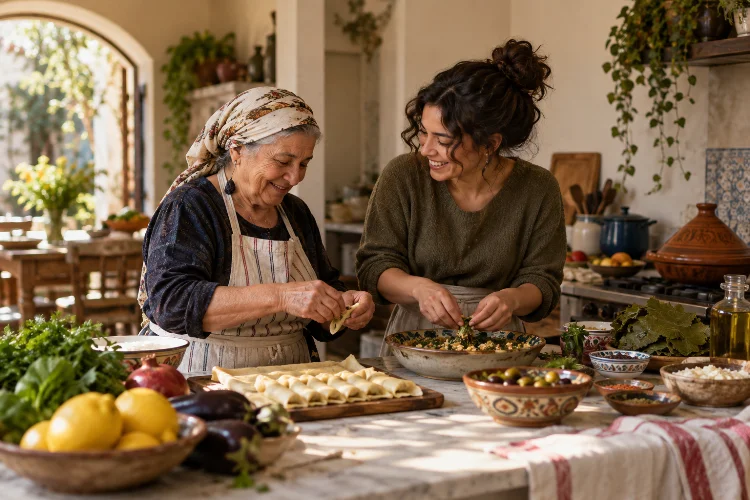
A grandmother’s recipe can cross an ocean and still taste like home, but it rarely arrives unchanged.
When people migrate, they carry more than luggage. They bring memories of family meals, cooking techniques, religious food customs, favorite spices, and recipes learned by watching parents or grandparents in the kitchen.
Once those traditions reach a new country, however, unfamiliar markets, different ingredients, new neighbors, and younger generations begin reshaping them.
That is the heart of how migration transformed traditional recipes across generations. A dish may begin as an attempt to recreate home as faithfully as possible, then slowly evolve through substitutions, mixed households, restaurant culture, and changing tastes.
Food scholars increasingly treat cuisine as an important record of human mobility. Oxford research on food and world history identifies migration, trade, and communication as major mechanisms through which culinary knowledge and practices move between societies.
The result is not simply “fusion food.” It is a living culinary history in which preservation and adaptation happen at the same time.
Migration Turns Food Into a Portable Piece of Home
For many migrants, food is one of the easiest parts of home to recreate after arriving somewhere unfamiliar.
A language may not be widely spoken in the new country, familiar festivals may happen differently, and relatives may live thousands of miles away. Cooking, however, can recreate smells and tastes associated with childhood almost immediately.
UNESCO describes foodways as part of both personal and shared cultural identity, carrying stories of migration, adaptation, resilience, and relationships between generations.
Culinary skills and social practices are often passed down through everyday acts such as preparing and sharing meals.
That emotional role explains why certain recipes survive migration particularly well.
Family dishes served during weddings, religious celebrations, holidays, or major gatherings tend to carry more meaning than ordinary weekday meals. Even when the recipe changes slightly, the ritual surrounding it can remain remarkably stable.
In this sense, a recipe functions almost like an edible family archive.
Ingredient Substitutions Create New Versions of Old Recipes
One of the first challenges migrant cooks face is surprisingly practical: finding the right ingrediants.
Today, international supermarkets and online shopping make specialty foods much easier to obtain. Earlier migrant communities often had fewer options. A particular herb, flour, vegetable, cheese, fish, or spice might simply have been unavailable or too expensive.
The solution was substitution.
A cook might replace one leafy vegetable with a locally available variety, switch flour types, use a different cut of meat, or adjust a sauce because a familiar fermented ingredient could not be purchased.
At first, those changes may feel temporary. But when children grow up eating the adapted version, it can become their definition of the traditional dish.
Research on migrant diets shows that some core staple foods can remain culturally important over several generations even while secondary ingredients and flavoring components change more easily in response to a new food environment.
That means adaptation does not automatically erase tradition. Sometimes substitution is exactly what allows a tradition to survive.
Diaspora Communities Develop Their Own Culinary Identities
When enough migrants settle in one place, their cooking can develop into a distinct diaspora cuisine rather than remaining an exact reproduction of food from the homeland.
Chinese diaspora cuisines provide a strong example.
Oxford research notes that Chinese food traditions outside China evolved through repeated adaptations to local ingredients, cooking techniques, consumer expectations, and the experiences of successive generations.
In Southeast Asia, Chinese culinary practices became deeply intertwined with local food cultures, while Chinese communities in the Americas and Australia developed different restaurant and household traditions.
This creates an important distinction.
Diaspora cuisine is not necessarily an inaccurate version of an “original” cuisine. It can become a legitimate food tradition with its own history.
The same process can occur wherever communities migrate. Family recipies interact with local agriculture, economic conditions, neighboring communities, and the tastes of people who were born in the new country.
Eventually, a new culinary identity emerges somewhere between memory and place.
Restaurants Accelerate the Evolution of Migrant Food
Home kitchens protect culinary traditions, but restaurants expose them to a much wider audience.
For migrant entrepreneurs, restaurants have historically offered both economic opportunities and a way to maintain connections with their communities.
Smithsonian research on immigrant foodways in the United States highlights how migrant cooks and food businesses have shared homeland traditions with fellow migrants while also introducing those foods to broader audiences.
Serving unfamiliar customers can change recipes.
Heat levels may be reduced. Portion sizes can increase. Ingredients may be replaced because of price or availability. Dishes that are considered everyday food at home may become signature restaurant items abroad.
Menus can also simplify regional differences.
A country with hundreds of highly localized dishes may initially be represented overseas by only a small selection of foods that customers recognize. As communities grow and diners become more curious, regional diversity often becomes more visible.
Restaurants therefore do more than preserve migrant cuisine. They actively participate in its evolution.
Second and Third Generations Reinterpret What “Traditional” Means
The children and grandchildren of migrants often experience food differently from the generation that moved.
For the first generation, a dish may evoke a specific village, city, household, or person. For someone born abroad, the same food may represent heritage more broadly.
That difference can change recipes.
Younger cooks may use modern appliances, shorten labor-intensive processes, change ingredients for convenience, or combine techniques from multiple cultures. They may also become curious about dishes their parents stopped preparing after migration.
Cambridge research on diaspora food writing describes how migrants use cooking and recipes to reconnect with memories of home while constructing identities across geographical and cultural boundaries.
This becomes even more complex in multicultural families.
A child might grow up eating one parent’s holiday dish with another parent’s spices, or a traditional stew alongside ingredients common in the country where the familly now lives.
Authenticity becomes less about freezing a recipe in time and more about deciding which parts of it still carry cultural meaning.
Migration Can Change a Recipe – and Later Change It Back
Culinary adaptation does not always move in one direction.
A migrant community may originally alter dishes because authentic ingredients are unavailable. Decades later, improved global supply chains, specialty grocery stores, online shopping, or new waves of migration can make those products accessible again.
Recipes can then move closer to styles currently eaten in the homeland.
This pattern is visible in Indonesian diaspora cooking in the Netherlands.
Smithsonian reported in 2026 that diaspora dishes there have been shaped by migration, economics, available ingredients, and identity, while increased access to Indonesian products has allowed some cooks to reconnect with ingredients that were previously difficult to find.
New migrants can also influence established communities.
Imagine a restaurant opened by a migrant family in the 1970s. By the 2020s, its recipes may have developed a distinctive local character. Newly arrived cooks from the same country might then introduce regional dishes and techniques that were previously uncommon.
Culinary heritage can therefore loop backward, forward, and sideways rather than following a straight line.
Recipes Preserve Memory Even When Measurements Disappear
Traditional recipes are not always written down.
In many households, instructions sound more like “add enough water,” “cook until it smells right,” or “use the same amount your grandmother used.” Knowledge is transmitted through observation, repetition, touch, smell, and taste.
Migration can make this informal system fragile.
When generations live farther apart or younger relatives speak a different primary language, culinary knowledge can become harder to transmit. A single missed generation may mean losing techniques that were never recorded.
At the same time, technology has created new forms of preservation.
Families now document cooking through messaging apps, videos, digital recipe books, and social media. Diaspora food blogs have likewise become spaces where recipes, memories, and cultural identity are recorded for audiences far beyond a single household.
The medium changes, but the purpose is familiar: keeping a connection alive.
Adaptation Does Not Automatically Make Food Less Authentic
Arguments about authenticity often assume that there was once a perfect, fixed version of a recipe.
Food history suggests otherwise.
Traditional cuisines have always changed as populations moved, trade expanded, climates shifted, technologies developed, and new ingredients became available. Even foods strongly associated with one location can contain layers of earlier cultural exchange.
UNESCO emphasizes that food heritage concerns living practices transmitted between generations rather than simply preserving individual dishes as unchanged objects.
That idea helps explain diaspora cooking.
Changing a vegetable because the original variety is unavailable does not necessarily destroy the dish’s meaning. Neither does using an electric appliance where a grandparent used a wood-fired stove.
The more useful question may be what the cook is trying to preserve.
Sometimes it is an exact flavor. Sometimes it is a technique, family ritual, memory, or simply the feeling of everyone gathering around the same table.
Understanding how migration transformed traditional recipes across generations reveals that culinary tradition is much more flexible than it first appears.
Migrants carry food memories into new environments, where ingredient availability, economics, restaurants, local tastes, and multicultural families reshape familiar dishes.
Later generations make further changes, sometimes modernizing recipes and sometimes actively recovering techniques that were lost.
Those changes do not automatically weaken culinary heritage. In many cases, adaptation is what keeps it alive.
Next time you cook a family recipe, ask where each ingredient, technique, and substitution came from.
Talk to older relatives, record their methods, and compare different versions of the same dish. You may discover that your dinner table holds a migration story spanning several generations.
