
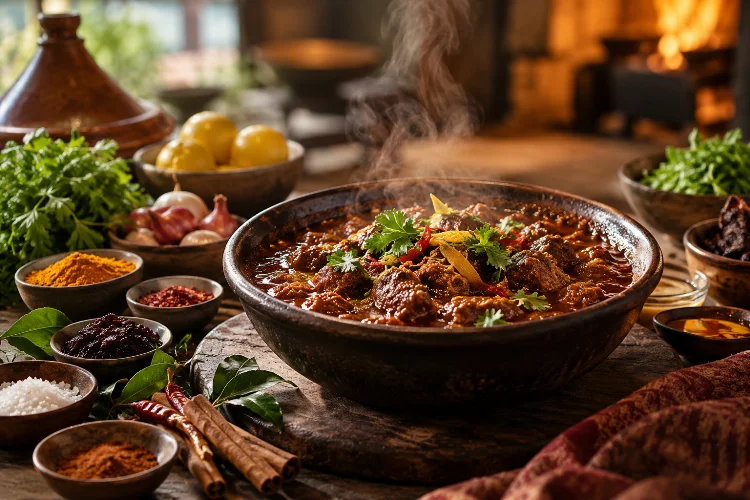
Take one bite of a deeply flavored curry, mole, tagine, noodle broth, or slow-cooked stew and something interesting happens.
You rarely taste just one thing. Sweetness may arrive first, followed by acidity, spice, smoke, saltiness, fermented depth, and a lingering aroma that seems difficult to describe.
That complexity is not simply the result of adding more ingredients. In many cuisines, layered flavor developed through centuries of cultural exchange, local agriculture, preservation, migration, religious traditions, conquest, and trade.
Tracing the cultural origins of layered flavor in world cuisine reveals that many supposedly “traditional” flavor combinations have surprisingly international histories.
Spices traveled across oceans, cooking techniques crossed borders, and foreign ingrediants were gradually transformed into symbols of local identity.
Even familiar combinations such as chili and garlic, rice and aromatic spices, or sweet-and-sour sauces often contain stories spanning several civilizations.
To understand why global food tastes the way it does today, we need to look at how those layers were built.
Layered Flavor Began With Local Landscapes
Before international trade became extensive, communities built flavor primarily from ingredients that grew or could be produced nearby.
Climate played a major role. Mediterranean societies had access to olives, grapes, herbs, wheat, and seafood, while tropical Asian regions offered different aromatic plants, rice varieties, fruits, and spices.
Pastoral communities developed strong traditions around meat and dairy, while coastal settlements naturally incorporated fish, shellfish, seaweed, and salt.
This produced what we might call a region’s first flavor vocabulary.
People learned which ingredients complemented one another and developed cooking methods suited to their environment. Roasting intensified sweetness, drying concentrated flavor, and grinding seeds or herbs released aromatic compounds.
The result was not random. Generations of cooks gradually refined combinations that worked with local ingredients, fuel availability, climate, and cultural preferences.
Yet these regional systems were never completely isolated.
Trade Routes Added New Layers to Familiar Foods
Some of the biggest changes occurred when long-distance trade introduced ingredients that local cooks had never encountered.
UNESCO describes the Silk Roads as interconnected land and maritime networks where spices, cereals, fruits, vegetables, goods, technologies, beliefs, and ideas circulated between societies across Eurasia.
Food moved with those networks.
Pepper from southern India, for example, entered trading systems that connected South Asia with distant markets.
Archaeological research at the ancient Sri Lankan port of Mantai has uncovered black pepper and even a clove originating thousands of kilometers away in Indonesia’s Maluku Islands.
These ingredients gave cooks additional tools.
A familiar meat dish could suddenly gain warmth from pepper. Rice could be combined with imported aromatic spices, nuts, or dried fruits. Existing sauces could become sweeter, sharper, or more fragrant.
The Smithsonian’s study of Silk Road food traditions similarly describes vegetables, grains, fruits, seasonings, breads, rice dishes, and cooking techniques moving between civilizations and being transformed into local specialties.
Layering flavor therefore became partly an act of cultural adaptation.
Preservation Techniques Created Complexity Before Refrigeration
Not every layer of flavor came from exotic ingredients. Some emerged because people simply needed food to survive longer.
Fermentation, salting, drying, smoking, pickling, and curing solved practical problems while creating entirely new tastes.
Fermented products are especially important because microorganisms transform basic ingredients into compounds that can taste sour, savory, fruity, funky, or intensely umami-rich.
Soy sauce, fish sauce, fermented bean pastes, cheeses, yogurt, sourdough, vinegar, and countless regional ferments demonstrate how preservation can become a flavor system.
Salt was equally influential. Cambridge’s history of spices and flavorings notes that salt has had a long culinary role not only as seasoning but also as a preservative.
Over time, communities stopped viewing these processes merely as storage techniques.
They became traditions.
A spoonful of fermented paste could provide saltiness, aroma, acidity, and deep savoriness at once. Combined with fresh herbs, toasted spices, fats, or stock, it created layers that were difficult to reproduce with fresh ingredients alone.
Migration Turned Recipes Into Moving Cultural Archives
People carry food traditions wherever they go.
Migration caused by trade, work, marriage, conflict, colonization, or displacement has repeatedly introduced cooking practices into new environments. Migrants often cannot find every ingredient they used at home, so recipes evolve.
Substitution becomes creativity.
A traditional herb may be replaced by a local equivalent. A familiar bread might be prepared with different flour. A sauce can become sweeter or hotter because locally available ingredients behave differently.
After several generations, these adapted recipies may develop identities of their own.
This explains why related culinary patterns appear across enormous geographical regions without being identical.
The Smithsonian’s Silk Road research, for example, points to related traditions involving flatbreads, dumplings, rice preparations, noodles, kebabs, and pastries stretching from East Asia through Central Asia and into the Mediterranean world.
Each destination added another cultural layer.
Conquest and Colonial Exchange Reshaped Entire Flavor Profiles
Culinary exchange was not always peaceful.
Empires, colonization, forced migration, and military expansion also changed what societies ate. Those histories should not be romanticized simply because they eventually produced influential foods.
One dramatic example is the movement of chili peppers.
Chili peppers originated in the Americas. After European voyages connected the Americas more intensively with Africa, Europe, and Asia, Capsicum varieties spread rapidly through Portuguese and Spanish maritime networks.
Today, chili feels inseparable from cuisines in India, Thailand, China, Korea, and many other parts of Asia. Yet those cuisines did not use American chili peppers before their introduction beginning around the sixteenth century.
The same transformation happened with tomatoes.
Tomatoes originated in the Americas but became so deeply incorporated into Mediterranean cooking that imagining many modern Italian dishes without them now seems almost impossible.
Smithsonian research highlights how ingredients such as tomatoes and potatoes could initially be viewed with suspicion in Europe before becoming embedded in local culinary traditons.
What feels ancient and local may therefore be relatively recent and international.
Cooking Techniques Matter as Much as Ingredients
Layered flavor is also created through sequence.
Two dishes containing exactly the same ingredients can taste completely different depending on when those ingredients are added.
Consider onions. Raw onions deliver sharpness. Slowly caramelized onions contribute sweetness and roasted depth. Charred onions add bitterness and smoke. Pickled onions introduce acidity.
The ingredient has not changed, but the cooking process has.
Many culinary traditions developed sophisticated sequences around this principle. Spices may be toasted before grinding, aromatics fried in fat, meat browned before simmering, or fresh herbs added only at the end.
Indian tempering techniques, French sauce building, Chinese wok cooking, Japanese broth preparation, and Middle Eastern spice roasting all demonstrate different approaches to constructing flavor in stages.
Instead of asking only, “What spices are used?”, it is often more revealing to ask, “What happens first?”
That sequence is frequently where culinary identity lives.
Sweet, Sour, Salty, Bitter, and Spicy Became Cultural Signatures
Layered flavor does not always mean using dozens of ingredients.
Often, complexity comes from balancing contrasting sensations.
Persian cooking is well known for combinations involving fruit, herbs, nuts, saffron, acidity, and sweetness. Southeast Asian dishes frequently play saltiness from fermented sauces against herbs, heat, sweetness, and citrus-like acidity.
Chinese regional cuisines use those relationships differently again. Some emphasize fermented depth, others numbing spice, gentle sweetness, vinegar, smoke, or chile heat.
These patterns eventually become recognizable regional signatures.
The fascinating part is that they continue changing. When a new ingredient enters an established culinary system, cooks rarely abandon everything they already know. Instead, they fit the newcomer into an existing structure.
Chili did not erase older Asian spices. It joined them.
Tomatoes did not replace Mediterranean cooking traditions. They became another tool inside them.
That process of absorption is one of the main engines behind culinary complexity.
Modern Fusion Is Older Than It Looks
“Fusion cuisine” often sounds like a modern restaurant trend, but food cultures have been blending for thousands of years.
Ancient ports were natural laboratories for culinary exchange. Mantai in Sri Lanka, for example, contained evidence of local foods alongside exotic products connected with long-distance Indian Ocean trade.
Researchers describe the site as a cosmopolitan environment where different culinary traditions interacted.
Caravan cities worked similarly.
Merchants passing through Central Asian trading centers exchanged more than merchandise. They encountered unfamiliar ingredients, preservation methods, dining customs, and preparation techniques.
What we now call fusion was often simply everyday adaptation.
The biggest difference today is speed. Air freight, refrigeration, global migration, restaurants, supermarkets, and social media allow ingredients and cooking ideas to move almost instantly.
But the basic process remains familiar: encounter something new, combine it with something known, then slowly make it your own.
Tracing the cultural origins of layered flavor in world cuisine shows that taste is really a form of history.
Local landscapes established the first flavor foundations, while trade introduced new spices and crops. Fermentation and preservation created depth, migration adapted recipes, and empires and maritime exchange redistributed ingredients across continents.
Cooking techniques then transformed those raw materials into distinctive regional identities.
The food we call traditional is therefore rarely frozen in time. It is an evolving record of human contact, creativity, necessity, and sometimes difficult historical change.
The next time you taste a complex curry, broth, stew, sauce, or spice blend, try identifying its layers seperately.
Then look into where those ingredients and techniques came from. You may discover that a single plate contains a story connecting several continents and hundreds of years.
