
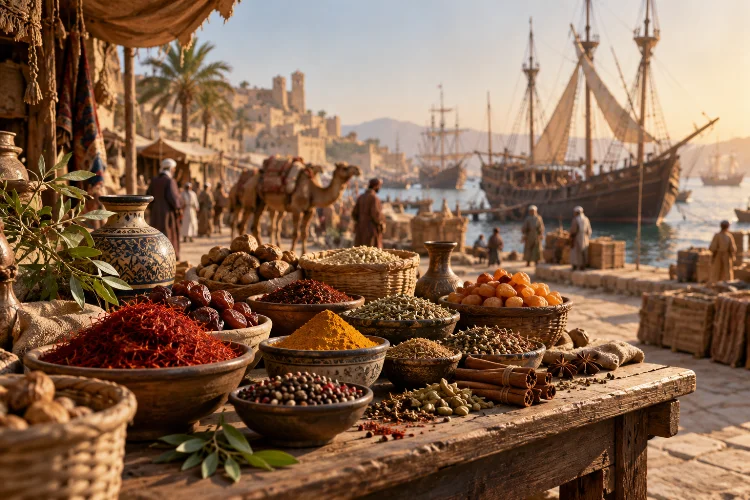
Long before refrigerated ships, cargo planes, and international supermarkets existed, cooks were already working with ingredients that had traveled thousands of kilometers.
Pepper harvested in South Asia could appear in Mediterranean kitchens, while fruits, grains, spices, and cooking ideas gradually moved between China, Central Asia, Persia, Arabia, Africa, and Europe.
Much of that movement happened through enormous commercial networks such as the Silk Roads, Indian Ocean routes, and Arabian caravan corridors. These networks did far more than transport expensive merchandise. They quietly changed what people considered delicious.
Understanding how ancient trade routes reshaped global culinary flavor profiles means looking beyond famous commodities like silk and precious metals.
Traders also moved seasonings, crops, preservation methods, cookware, and culinary knowledge. Over generations, foreign ingredents stopped feeling foreign at all.
Many dishes that seem deeply tied to one region are actually products of centuries of cultural exchange. Behind everyday combinations of bread, rice, meat, herbs, fruit, and spice lies an old story of merchants, ports, caravan cities, and surprisingly interconnected kitchens.
Ancient Trade Routes Were Also Culinary Highways
The term Silk Road can sound like a single highway running directly from China to Europe. In reality, it described a large network of interconnected land routes, while maritime networks connected many of the same regions through the Indian Ocean.
National Geographic notes that Silk Road trade operated for more than 1,500 years and connected communities across thousands of kilometers.
Merchants rarely traveled from one end to the other. Products instead passed through numerous intermediaries, markets, oasis towns, and ports.
That structure was important for culinary history.
Every stop offered an opportunity for an ingredient to enter a local kitchen. A spice might begin as an expensive imported luxury, become popular among wealthy households, and eventually inspire local cultivation or new recipes.
Food knowledge could travel in exactly the same way. Merchants and migrants brought ideas about bread making, grilling, fermentation, rice preparation, sauces, and spice combinations alongside physical commodities.
The result was cultural exchange that happened one meal at a time.
The Spice Trade Changed the Geography of Flavor
Few products demonstrate this transformation better than spices.
Black pepper originated in southwestern India but became highly valued far beyond its native region. Historical and archaeological evidence shows an active pepper trade connecting southern India with markets linked to the Roman world.
Imagine what this meant for ancient cooking.
A kitchen previously dominated by locally available herbs, salt, vinegar, or fermented sauces could suddenly gain the sharp heat and fragrance of pepper. Once diners became accustomed to that flavor, demand encouraged even larger commercial networks.
Cloves traveled even farther. The clove tree is native to Indonesia’s Maluku Islands, yet archaeological and historical evidence points to cloves moving west through South and Southeast Asian trading systems.
A clove discovered at ancient Mantai in Sri Lanka illustrates just how far these ingredients could travell before reaching consumers.
Spices therefore changed cuisine not merely by adding individual tastes. They expanded the basic flavor vocabulary available to cooks.
Silk Road Kitchens Exchanged Ingredients and Techniques
Food exchange involved much more than small bags of expensive seasoning.
The Smithsonian’s exploration of Silk Road cooking highlights similarities in breads, rice dishes, kebabs, pastries, soups, and other foods stretching from China through Central Asia and Persia toward the Mediterranean.
Vegetables, grains, fruits, seasonings, and cooking techniques circulated through these networks and were repeatedly adapted by local communities.
Consider flatbreads.
Related bread traditions appear across Central Asia, Iran, Afghanistan, Pakistan, India, and western China.
Their exact recipes and forms vary enormously, but recurring techniques – including baking dough against the heated walls of clay ovens – show how culinary practices could spread and then become regionalized.
Rice followed a similar pattern. Instead of simply moving a crop from one location to another, societies developed different combinations of rice, meat, dried fruit, vegetables, aromatic spices, and fats.
Culinary exchange rarely produced exact copies. Local cooks absorbed an idea and made it their own.
Indian Ocean Trade Created a Massive Flavor Network
Overland caravans receive much of the attention, but maritime commerce was equally important.
Indian Ocean networks connected East Africa, Arabia, India, Sri Lanka, Southeast Asia, and parts of China. Monsoon winds created predictable seasonal sailing patterns, allowing merchants to transport cargo across remarkable distances.
Roman-era traders were already using maritime routes connecting Egypt and the Red Sea with Indian markets. Sources describe Indian pepper and other Asian spices among highly desirable imports moving westward.
Sri Lanka provides especially interesting archaeological evidence.
Researchers studying the ancient port of Mantai identified food remains associated with both local consumption and long-distance exchange. Black pepper, cloves, rice, and evidence of imported foods point toward a trading settlement connected to multiple culinary regions.
A busy port could therefore become a kind of ancient culinary laboratory.
Sailors, traders, dockworkers, religious travelers, and local residents all brought different food habits together. Restaurants in the modern sense may not have dominated these places, but markets, households, inns, and merchant communities created opportunities for flavours to mix.
Caravan Cities Became Early Centers of Fusion Cuisine
Certain cities became influential because they sat at crossroads rather than because they produced every commodity themselves.
Places such as Samarkand, Bukhara, Xi’an, and major Persian trading cities connected merchants from very different cultural backgrounds. Caravanserais offered travelers places to rest, exchange goods, communicate, and share knowledge.
UNESCO describes the Silk Roads as networks that transferred not only luxury goods but also foodstuffs, raw materials, knowledge, and technologies between societies.
That constant movement encouraged culinary hybridization.
A cook could combine a familiar local grain with imported spices. Foreign nuts or dried fruits might enter established meat dishes. A cooking method learned from travelers could be applied to completely different regional ingredients.
Over generations, the hybrid dish no longer looked hybrid.
It simply became “local food.”
This is one reason tracing the exact origin of old recipies can become surprisingly complicated. Cuisine evolves through repeated borrowing rather than following neat national borders.
Luxury Ingredients Eventually Became Culinary Identities
Another fascinating pattern is how imported ingredients can become essential to regional identity.
Initially, long-distance spices were often expensive because transportation was difficult and dangerous. Their rarity made them attractive to elites, religious institutions, wealthy merchants, and royal households.
But successful trading networks could gradually increase availability.
Repeated exposure mattered. Once cooks understood how a spice interacted with meat, grains, sauces, sweets, or preserved foods, it became integrated into established cooking systems rather than remaining a novelty.
Smithsonian’s history of the spice trade shows how valuable commodities such as pepper influenced international commerce for centuries.
This process helps explain an important culinary paradox: something can become deeply traditional in a region even when the ingredient originally came from somewhere else.
Tradition is often the result of successful adaptation.
Ancient Food Exchange Still Shapes Modern Cuisine
Walk through modern markets from Istanbul to Samarkand, Delhi, Xi’an, or Southeast Asia and traces of these historical connections are still visible.
Cumin, coriander, pepper, sesame, dried fruit, aromatic rice, grilled meat, stuffed breads, noodles, dumplings, nuts, and countless other ingredients appear in different combinations across enormous geographical areas.
That does not mean every similar dish has one common origin. Food history is considerably messier than that.
What ancient commerce created was a shared environment for experimentation.
World History Encyclopedia describes medieval Eurasian commerce as an interconnected system stretching from China toward Western Europe through maritime and overland corridors. These connections built upon networks that had existed in various forms for centuries.
Modern globalization accelerated the process dramatically, but it did not invent culinary globalization.
Ancient merchants had already started changing the world’s taste buds.
Ancient trade networks were among history’s most powerful forces of culinary change.
Silk Road caravans, Indian Ocean sailors, Persian merchants, Arabian trading centers, and Southeast Asian spice producers moved far more than valuable commodities. They carried tastes, techniques, habits, and ideas.
Through centuries of exchange, pepper from India, cloves from Maluku, grains, fruits, breads, rice traditions, and cooking methods entered new communities and were transformed into something locally meaningful.
Understanding how ancient trade routes reshaped global culinary flavor profiles also changes how we think about “traditional” cuisine. Many food traditions are not isolated inventions but layers of cultural interaction built across generations.
Next time you encounter an intensely aromatic spice blend, unfamiliar bread, or centuries-old rice dish, look into its history. The recipe may reveal a journey stretching far beyond the kitchen where it is served.
