
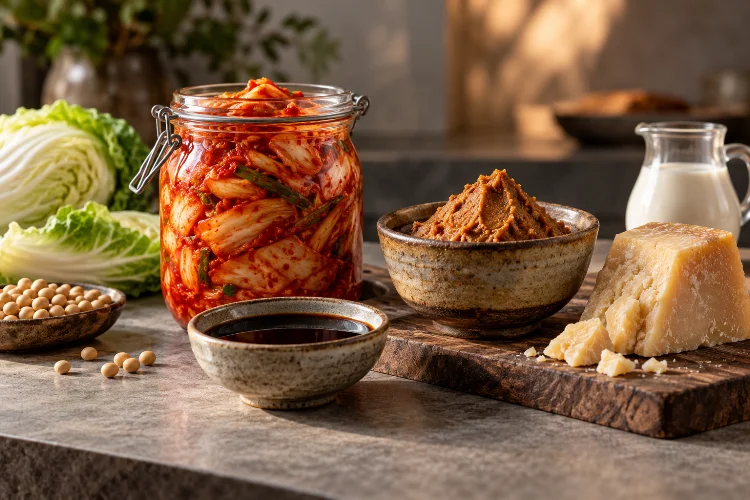
Fresh soybeans do not taste like soy sauce. Cabbage straight from the field tastes nothing like mature kimchi, and fresh milk has nowhere near the savory complexity of a well-aged cheese.
The missing ingredient is not another spice. It is fermentation.
Understanding how fermentation builds umami and complexity in traditional foods means looking at what microorganisms and enzymes do to proteins, carbohydrates, fats, and aromatic compounds over time.
Fermentation breaks large molecules into smaller ones, creates organic acids, releases free amino acids, and generates hundreds of compounds that can influence taste and smell.
One of the most important is glutamate, an amino acid strongly associated with umami, the savory taste found in foods such as soy sauce, fish sauce, aged cheese, and fermented beans.
Traditional cooks discovered these transformations centuries before food chemistry could explain them.
Across Asia, Europe, Africa, and the Americas, fermentation became both a preservation strategy and a powerful way to make relatively simple ingrediants taste dramatically more complex.
Fermentation Unlocks Umami Hidden Inside Proteins
Many protein-rich foods contain plenty of glutamate, but there is an important catch.
When glutamate remains bound inside a large protein molecule, we do not experience its taste in the same way. Fermentation can change that through proteolysis – the breakdown of proteins into smaller peptides and free amino acids.
Research on umami chemistry notes that proteins in foods such as soy, wheat, milk, and meat can contain substantial amounts of glutamate.
During fermentation, proteolytic enzymes release some of that glutamate into its free form, where it can contribute directly to savory taste.
Soy sauce is a classic example.
During fermentation, enzymes break soybean and wheat proteins into free amino acids. Glutamate and aspartate are particularly important contributors to umami, while other amino acids may introduce sweetness, bitterness, or additional depth.
The process is almost like unlocking flavor that was already inside the food.
Microorganisms Create More Than Just Savory Taste
Fermentation would be much less interesting if it only produced glutamate.
Microorganisms also generate acids, alcohols, esters, aldehydes, ketones, peptides, and many other flavor compounds. Together, they create the aromas and secondary tastes that make fermented foods feel layered rather than simply salty or savory.
Soy sauce demonstrates this remarkable complexity.
Scientific reviews describe aroma compounds associated with caramel-like, floral, smoky, malty, and cooked notes.
Researchers have identified acids, alcohols, aldehydes, esters, furanones, pyrazines, and sulfur compounds among the chemicals contributing to its overall sensory profile.
That explains why good soy sauce tastes like much more than liquid salt and glutamate.
Its flavor emerges from an entire chemical ecosystem.
Different microorganisms also produce different metabolic products, so changing the starter culture, fermentation temperature, raw materials, salt concentration, or aging period can alter the final result.
Fermentation is therefore controlled transformation, not simply letting food sit around.
Koji Turns Soybeans and Grains Into Flavor Factories
One of the most sophisticated traditional fermentation systems involves koji.
Koji is produced by growing molds such as Aspergillus oryzae on ingredients including rice, barley, or soybeans. The mold creates enzymes capable of breaking complex starches and proteins into smaller molecules.
Proteases release amino acids from proteins, while amylases break starch into simpler sugars.
Those sugars and amino acids then become fuel and building blocks for additional microbial reactions.
This enzymatic activity is fundamental to products such as miso and many styles of soy sauce. It helps explain why something as basic as soybeans can develop deep savory, sweet, roasted, fermented, and slightly alcoholic characteristics after a long maturation.
Solid-state fermentaion with culinary fungi can also increase taste-active substances including L-glutamate and certain nucleotides associated with umami. Fermentation may simultaneously create precursors that later form roasted aromas when the food is heated.
So fermentation does not merely create flavor during aging.
It can also prepare ingredients to develop even more flavor during later cooking.
Nucleotides Make Umami Feel Stronger
Glutamate is central to umami, but it does not always work alone.
Certain nucleotides – including inosinate, or IMP, and guanylate, or GMP – can strengthen savory perception when present alongside amino acids such as glutamate.
This creates an important form of flavor synergy.
Research into traditional fermented foods shows that microorganisms can contribute to nucleotide metabolism, producing compounds that interact with glutamate and aspartate to enhance umami intensity.
That means one plus one can effectively taste like more than two.
Traditional cooks obviously did not discuss IMP or GMP at the dinner table. They simply noticed that certain ingredients tasted exceptionally good together.
This principle helps explain why fermented condiments work so effectively with broths, mushrooms, meats, seafood, and other naturally savory foods.
A spoonful of fermented seasoning may not just add its own flavor.
It can amplify flavors already present in the dish.
Fish Sauce Builds Savory Depth Through Protein Breakdown
Fish sauce is one of the clearest examples of fermentation turning intense raw material into a powerful seasoning.
Traditional versions generally begin with fish and salt. Over time, enzymes break proteins into peptides and free amino acids while numerous chemical and microbial processes contribute additional flavors.
Historical evidence shows that this idea is far from modern.
Fermented fish sauces were already important in classical antiquity, while related condiments remain essential throughout Southeast Asia today.
Research on umami notes that fish sauce can contain substantial levels of free glutamate because fish proteins are broken down during prolonged processing.
The final condiment is extremely concentrated.
You probably would not drink a bowl of fish sauce, but a small quantity can dramatically deepen soups, curries, dipping sauces, marinades, and stir-fries.
This reveals one of fermentation’s most useful culinary functions: concentrating complex taste into an ingredient that can season much larger quantities of food.
Kimchi Shows How Acidity and Umami Develop Together
Kimchi demonstrates that fermented complexity does not need to be purely savory.
Lactic acid bacteria consume sugars in vegetables and generate organic acids, especially lactic acid. As fermentation progresses, the food becomes increasingly sour while numerous amino acids and aromatic compounds also change.
Studies tracking kimchi fermentation show substantial increases in lactic acid during maturation, directly influencing its characteristic sourness.
At the same time, free amino acids contribute additional taste.
Traditional kimchi may contain salted seafood such as jeotgal, which can introduce extra protein and savory compounds. Research has found that adding fish ingredients can raise amino acid levels associated with savory characteristics during fermentation.
This combination is important.
Good fermented food rarely delivers one isolated sensation.
Kimchi can be sour, salty, spicy, aromatic, slightly sweet, and intensely savory within the same bite.
Complexity comes from interaction.
Fermentation Can Build Mouthfulness Beyond Basic Umami
Some fermented foods feel unusually rich even when they are not particularly fatty.
Researchers sometimes discuss this sensation using the Japanese concept kokumi.
Kokumi is not usually described as a conventional basic taste. Instead, it refers to qualities such as mouthfulness, continuity, richness, and lingering flavor.
Certain peptides, including gamma-glutamyl peptides, have been investigated for their ability to enhance these sensations.
Fermented foods such as soy sauce, aged cheese, and fermented meats can contain compounds associated with this effect. A review of soy sauce chemistry notes that microbial activity may generate substances that enhance richness and the perception of other tastes, including umami.
That helps explain why replacing a traditional fermented ingredient with plain salt often produces disappointing results.
Salt can provide saltiness.
It cannot automatically reproduce the peptides, amino acids, acids, sugars, and aromatic compounds that fermentation creates.
The missing quality is often not stronger seasoning but greater dimensionality.
Fermentation Time Changes the Flavor Architecture
More fermentation is not always better.
Flavor moves through stages.
Early fermentation may preserve more fresh characteristics. As microorganisms become active, acidity rises and new aromatic compounds appear. Extended aging can produce deeper savory flavors, stronger aromas, and greater chemical complexity.
Eventually, however, a food can become overly sour, bitter, alcoholic, soft, or pungent if the process continues beyond the desired point.
Kimchi makes this progression easy to understand.
Freshly prepared kimchi can taste crisp, spicy, and vegetable-forward. Moderately fermented kimchi gains acidity and integrated flavor, while long-aged versions become increasingly sour and intense.
Recent research on aged kimchi found that starter cultures and fermentation stages influenced concentrations of glutamic acid, aspartic acid, organic acids, and other compounds associated with umami and overall taste.
Traditional recipes therefore depend not only on ingredients but also on time.
Fermentation time becomes part of the seasoning.
Salt Controls the Fermentation Environment
Salt does much more than make fermented foods salty.
In many traditional processes, it helps create an environment where desired microorganisms can compete successfully while undesirable microbial activity is suppressed.
This is especially important in vegetable fermentation.
Lactic acid bacteria can thrive under conditions that discourage many spoilage organisms, gradually converting sugars into acids and lowering pH.
FAO describes fermented vegetables as products commonly created through the action of lactic acid bacteria, often in the presence of salt and relatively low-oxygen conditions.
Too much salt, however, can slow microbial activity.
Too little may reduce process stability.
Traditional measurements such as handfuls, ratios, brines, and experienced sensory judgement therefore represented practical microbiology long before anyone could see bacteria through a microscope.
Generations of cooks learned to manage a microscopic ecosystem using nothing more than salt, temperature, containers, and time.
Fermentation Creates Regional Culinary Identities
One reason fermentation remains so culturally important is that there is no single universal fermented flavor.
Different communities work with different raw materials, microorganisms, climates, containers, and aging methods.
Soybeans become miso, tempeh, soy sauce, or fermented bean pastes depending on processing. Milk can become yogurt or thousands of different cheeses. Vegetables become kimchi, sauerkraut, pickles, or other regional ferments.
FAO documentation of traditional fermented foods shows an enormous diversity of fermented grains, legumes, dairy products, vegetables, beverages, and condiments around the world.
Each represents local problem-solving.
People needed ways to preserve harvests and make foods safer or more useful. Over time, those practical techniques developed into flavor traditions that communities actively preferred.
What began as preservation became cuisine.
That is perhaps fermentation’s most fascinating developement: humans learned not merely to tolerate microbial transformation, but to deliberately design food around it.
Understanding how fermentation builds umami and complexity in traditional foods reveals why fermented ingredients can transform even simple dishes.
Proteolysis releases glutamate and other amino acids, while microbial metabolism creates acids, nucleotides, peptides, alcohols, and aromatic compounds.
Together, these molecules produce savory depth, acidity, sweetness, bitterness, aroma, and lingering richness that fresh ingredients cannot always provide seperately.
Foods such as soy sauce, kimchi, miso, fish sauce, cheese, and fermented vegetables are therefore more than preservation technologies. They are carefully developed flavor systems.
Try comparing a fresh ingredient with its fermented counterpart and pay attention to more than saltiness or sourness.
Notice the aroma, aftertaste, mouthfeel, and savory depth. That simple comparison makes centuries of fermentation knowledge surprisingly easy to taste.
