
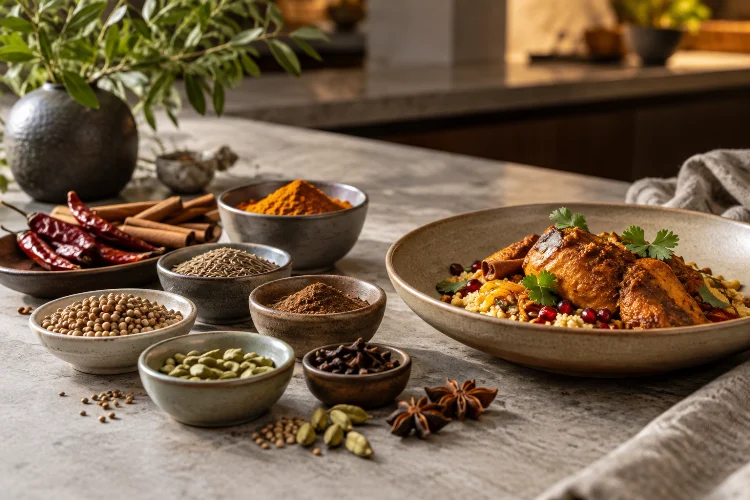
Open a jar of garam masala, ras el hanout, Chinese five-spice, or another traditional spice blend and the aroma can be surprisingly intense. Yet once that mixture enters a well-made dish, something interesting happens: no single spice necessarily dominates.
That balance is not accidental.
Understanding how traditional spice blends achieve balance without overpowering food means looking at much more than ingredient lists.
Successful blends depend on proportion, aroma intensity, cooking stage, fat, acidity, heat, and even the texture of the food they season. Generations of cooks developed these relationships long before flavor chemistry became a scientific field.
They discovered that powerful spices could work together when each had a specific role. One might provide warmth, another freshness, another bitterness, and another a sweet aromatic note.
Traditional blends therefore behave less like collections of spices and more like carefully arranged flavor systems.
Once you understand that idea, spice blending becomes much easier. The goal is not maximum intensity. It is controlled complexity that makes the food itself taste more interesting.
Traditional Spice Blends Are Built Around Roles, Not Random Ingredients
A good spice blend rarely treats every component equally.
Some spices form the foundation. Coriander, cumin, or mild chile may provide the majority of the blend because their flavors can support other ingredients without becoming immediately overwhelming.
More assertive spices are normally used in smaller quantities.
Cloves, star anise, cardamom, nutmeg, fenugreek, and similar aromatics can dominate quickly. Their job is often to add a recognizable high note rather than become the entire flavor profile.
Ras el hanout provides a useful example. Recipes vary considerably, but common versions combine spices such as coriander, cumin, cinnamon, pepper, ginger, cloves, and hotter seasonings in different proportions.
The name itself is commonly translated as “top of the shop,” reflecting the idea of a merchant’s preferred mixture.
The lesson is simple: balance comes from hierarchy.
Not every spice needs equal space.
Strong Spices Work Better When Surrounded by Softer Flavors
One intensely aromatic ingredient can transform an entire dish.
Star anise is a good example. Its sweet, licorice-like aroma is powerful enough that too much can quickly overwhelm meat, broth, or rice.
Yet it works beautifully inside blends such as Chinese five-spice because it is surrounded by other aromatic elements rather than left completely exposed. Star anise is also used in rice dishes, soups, meat preparations, and several South and Southeast Asian culinary traditions.
This suggests a practical rule for home cooks.
When working with a particularly dominant spice, reduce its quantity rather than removing it entirely. A small amount can provide depth that diners notice without necessarily being able to identify.
The same idea applies to cloves.
A dish seasoned primarily with cloves can taste medicinal. Combine a small amount with cinnamon, coriander, cumin, pepper, or ginger and the clove becomes one layer inside a larger aromatic structure.
Traditional spice blending is often about controlling the strongest voice in the room.
Toasting Changes Aroma Before the Spices Reach the Dish
The same spice can taste noticeably different depending on how it is prepared.
Dry-toasting whole spices before grinding them is common in many culinary traditions because heat changes their aromatic profile. Warming seeds can release volatile compounds and create deeper roasted notes.
But there is a limit.
Spices that are gently toasted can smell warm and fragrant. Push them too far and delicate aromas disappear while bitterness becomes more obvious.
This is why experienced cooks often toast spices individually or monitor them carefully.
Cumin seeds may need a different amount of time from cloves or coriander. A blend containing several whole spices can therefore require more judgement than simply heating everything until it turns dark.
Grinding also matters.
Freshly ground spices generally deliver stronger aromatics than powders that have been sitting in a cupboard for months. Traditional methods often used whole spices partly because their aromatic compounds could be released closer to the actual cooking time.
Freshness allows cooks to use less while still getting plenty of flavor.
Timing Determines Whether Spices Blend or Dominate
Adding the right spice at the wrong moment can change the entire dish.
Some spices benefit from being cooked in fat near the beginning. Their fat-soluble aromatic compounds disperse through oil or clarified butter, allowing the seasoning to spread throughout the food.
Other aromatics work better near the end.
A finishing sprinkle of garam masala, for example, can provide a fresh aromatic lift that would be reduced if the mixture simmered for several hours.
South Asian cooking offers countless examples of spices being introduced at different stages. Rasam, a South Indian preparation, can contain combinations of black pepper, coriander, cumin, mustard, chile, turmeric, tamarind, curry leaves, and other ingrediants.
Different forms of rasam alter those combinations and proportions to produce distinct flavor profiles.
This staged approach prevents everything from becoming one flat wall of spice.
Some flavors become deep background notes. Others remain bright and noticeable.
Balance is partly about deciding when each flavor should speak.
Fat, Acid, Salt, and Sweetness Keep Spices in Perspective
Spices never operate alone.
The surrounding dish changes the way we perceive them.
Fat can soften harsh edges and carry aromatic compounds throughout a sauce. Acidity can brighten earthy spices, while sweetness may reduce the perception of bitterness or aggressive chile heat.
Salt has its own role.
Used carefully, it makes existing flavors seem more vivid rather than simply making food salty.
This explains why a spice blend that seems aggressive when tasted dry may become surprisingly balanced inside yogurt, coconut milk, tomato sauce, stock, or a meat braise.
The food itself acts as a flavor framework.
Traditional cooks therefore rarely judge a spice blend only from the powder. They judge what happens after it interacts with the other components of a dish.
That distinction is crucial.
A balanced blend is not necessarily mild. It is a mixture whose intensity makes sense within the food around it.
Regional Blends Reflect What People Actually Cook
Traditional spice blends evolved alongside specific cuisines.
Panch phoron, associated with eastern India and also used in Bangladesh and Nepal, commonly contains five whole seeds: cumin, fennel, fenugreek, black mustard, and nigella.
Research on Nigella sativa identifies the spice as an important component of this traditional five-spice mixture.
These ingredients are not combined just because they smell interesting together.
They are used in a culinary environment containing vegetables, legumes, fish, oils, and other foods where the mix makes practical sensory sense.
The same principle applies elsewhere.
North African blends developed around local dishes and trading histories. Chinese spice combinations fit braised meats, stocks, and other regional preparations. South Asian masalas vary according to dish, household, and geography.
Even Britain’s mixed spice evolved as a combination suited to particular baked goods, puddings, savory preparations, and later global adaptations. Historical versions include combinations of cinnamon, nutmeg, allspice, cloves, coriander, mace, and ginger.
A spice blend works best when it has a job.
Spice Trade History Helped Create More Complex Blends
Many famous spice combinations also reflect centuries of trade.
Archaeological research from the ancient Red Sea port of Quseir al-Qadim demonstrates long-distance movement of tropical spices during Roman and medieval Islamic periods.
Such trading systems connected South and Southeast Asian ingredients with markets thousands of kilometers away.
As more spices became available, cooks gained a larger flavor vocabulary.
Cinnamon could meet pepper. Cloves could appear beside cumin. Imported aromatics could be integrated with local herbs, seeds, acids, and fats.
Indian spices later became especially important commodities in international trade. Pepper, cinnamon, cumin, ginger, nutmeg, cloves, and saffron were among the valuable spices reaching European markets during medieval and early modern periods.
These exchanges made spice blending increasingly complex.
However, complexity did not mean using everything available.
Experienced cooks still selected particular combinations according to the food being prepared.
That restraint is probably one of the oldest lessons in spice cookery.
More Spices Do Not Automatically Create More Flavor
One of the easiest mistakes is assuming that a longer spice list means a more sophisticated dish.
It does not.
Adding too many assertive aromatics can make individual ingredients harder to recognize. Instead of complexity, the dish develops confusion.
Traditional blends often succeed because they contain contrast without chaos.
Earthy cumin can sit beside citrus-like coriander. Warm cinnamon can soften peppery heat. Fennel can contribute sweetness while fenugreek adds a slight bitter quality.
The exact balence depends on the cuisine and preparation.
Even “curry powder” demonstrates how flexible these relationships can become. Rather than representing one universal Indian mixture, curry powders developed into numerous regional forms around the world.
Common components can include turmeric, coriander, cumin, and fenugreek, but proportions and additional seasonings vary considerably.
For home cooks, the practical lesson is useful: start with fewer spices and understand what each one contributes.
You can always add complexity later.
Grinding Size Can Change How Quickly Flavor Appears
Flavor intensity is affected by physical form as well as quantity.
Whole spices release their aromatics more gradually. Finely ground spices expose far more surface area, allowing flavor to disperse quickly.
That makes grinding size a form of control.
Whole peppercorns simmering in broth behave differently from a spoonful of finely ground pepper. A whole cinnamon stick adds aroma gradually, while cinnamon powder spreads immediately throughout the dish.
Traditional preperation methods often take advantage of this difference.
Some recipes combine whole and ground spices precisely because they need multiple layers of aromatic release.
This creates depth over time.
Instead of every seasoning becoming obvious in the first bite, some flavors remain in the background while others appear immediately.
That slow unfolding is one reason carefully spiced food can taste complex without tasting aggressively “spicy.”
Traditional spice blends achieve balance because they are built around proportion, timing, technique, and context rather than sheer intensity.
Foundation spices create structure, while powerful aromatics are used more carefully. Toasting changes fragrance, grinding controls release, and cooking spices at different stages creates layers.
Fat, acidity, salt, and sweetness then influence how those seasonings are perceived.
Centuries of trade and cultural exchange expanded the number of spices available, but generations of cooks learned that restraint remained just as important as variety.
Try applying the same thinking in your own kitchen. Instead of adding more seasoning automatically, identify what each spice contributes and adjust its role. The goal is not to make diners notice every spice individually – it is to make the entire dish taste more complete.
