
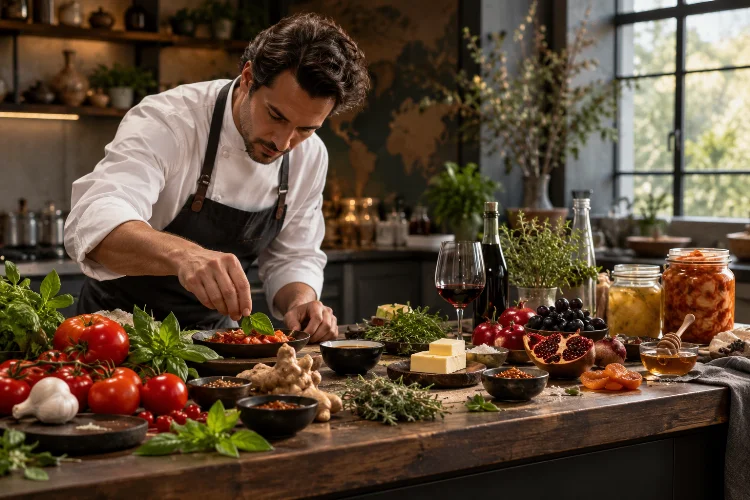
Why does tomato work so naturally with basil, while soy sauce seems almost made for ginger? Why do some cuisines combine sweetness with intense chile heat, while others build depth through butter, herbs, wine, or fermented ingredients?
These combinations may feel obvious today, but most were shaped over centuries.
Geography determined which foods were available, trade introduced unfamiliar spices, migration mixed culinary traditions, and preservation techniques created entirely new flavors. Even politics, religion, climate, and economics influenced what eventually became considered a “classic” pairing.
Exploring the hidden history behind complex flavor pairings across cultures reveals that food combinations are rarely accidental.
Some developed through chemistry and sensory compatibility, while others survived simply because generations of cooks discovered that they tasted good together.
Modern research also suggests there is no single universal rule for pairing ingredients. Different cuisines organize flavors in noticeably different ways, showing how strongly culture influences taste.
Behind almost every memorable dish, there is a much longer cultural story.
Geography Created the First Flavor Pairings
Before global shipping and supermarkets, cooks mostly worked with what grew, grazed, or could be preserved nearby.
Mediterranean communities naturally built combinations around olive oil, wheat, grapes, herbs, seafood, and locally raised animals.
In parts of South and Southeast Asia, tropical climates supported completely different flavor systems involving rice, aromatic roots, spices, coconut, and fermented products.
Availability created repetition, and repetition gradually created tradition.
When generations repeatedly cooked the same ingrediants together, they learned which combinations produced balance. Acid could cut through rich fat. Aromatic herbs could brighten meat. Salt could strengthen sweetness while also extending shelf life.
This is one reason regional cuisines developed recognizable flavor identities long before anyone understood flavor chemistry.
Modern research still finds distinctive “culinary fingerprints” in the way cuisines combine ingredient categories. A 2025 npj Science of Food study found that ingredient-combination networks can reveal meaningful geographic and cultural patterns between world cuisines.
The Spice Trade Completely Expanded the Flavor Map
Local geography established the foundation, but long-distance trade dramatically increased what cooks could do with it.
The Silk Roads were not one road but interconnected land and maritime networks linking East Asia, Central Asia, South Asia, the Middle East, Africa, and Europe. Food products traveling these routes included spices, cereals, fruits, vegetables, and other agricultural goods.
Spices were particularly transformative.
Black pepper from southern India became highly valued far beyond its native region.
Cinnamon, cloves, ginger, nutmeg, and other aromatics also moved through commercial networks, allowing cooks to introduce heat, fragrance, bitterness, sweetness, and warmth into familiar dishes.
Cambridge’s World History of Food notes that many spices historically functioned not only as flavorings but also in preservation and other culinary roles.
Once imported spices entered local cooking, they rarely remained isolated additions. Cooks paired them with existing meats, grains, fats, fruits, and sauces.
A foreign spice could eventually become so integrated that later generations considered the pairing completely traditional.
Medieval Trade Centers Became Flavor Laboratories
Large trading cities were especially important because they brought unfamiliar culinary systems into direct contact.
Medieval Arab cuisine offers a fascinating example. Expanding trade networks across the Mediterranean, Indian Ocean, and Silk Roads brought ingredients from Persia, Central Asia, India, Southeast Asia, North Africa, and China into connected markets.
UNESCO documents ingredients such as rice, roses, pomegranates, pistachios, saffron, cinnamon, nutmeg, cloves, and melons circulating through this enormous commercial environment.
Imagine what that meant for a cook.
A meat preparation could now be paired with dried fruit, nuts, sour elements, fragrant spices, and floral ingredients that had originated in very different places. Sweet and savory boundaries became more flexible.
Many combinations associated with Middle Eastern cooking today reflect this long history of contact.
Trade did more than increase the number of foods available. It multiplied the possible relationships between them.
Fermentation Created Flavor Through Controlled Transformation
Some of the world’s most complex flavor pairings were not created by combining more ingredients at all.
They came from transforming existing ones.
Fermantation allows microorganisms to convert sugars and other compounds, producing acidity, aroma, alcohol, carbon dioxide, and powerful savory characteristics. Humans discovered different forms of fermentation independently in many regions.
That gave cuisines ingredients such as soy sauce, miso, fish sauce, vinegar, cheese, yogurt, fermented bean pastes, sourdough, and alcoholic beverages.
These products became extraordinarily useful for flavor building because small amounts could change an entire dish.
Consider soy sauce with ginger and scallion. Fish sauce with lime and chile works differently, yet it follows a similar principle: an intensely savory fermented base is balanced with freshness, acidity, sweetness, aroma, or heat.
Preservation necessity had accidentally become culinary sophistication.
Salt played a similar role. Historical research shows that salt has been used for thousands of years both as seasoning and as a preservation tool, influencing the development of cured, dried, pickled, and fermented foods.
Different Cultures Do Not Follow the Same Pairing Rules
One popular idea in modern gastronomy is that ingredients pair successfully because they share similar aroma compounds.
There is some evidence for this, but the story becomes much more interesting when different cuisines are compared.
A landmark 2011 Scientific Reports study examined tens of thousands of recipes through a network of flavor compounds.
Researchers found that North American and Western European cuisines showed a tendency to combine ingredients sharing flavor compounds.
East Asian cuisines showed almost the opposite pattern, frequently combining ingredients that shared fewer compounds.
That matters because it challenges the idea of a universal “correct” food-pairing formula.
Cultural experience is enormously important.
One cuisine may create harmony through similarity, while another creates excitement through contrast. A successful combination might balance rich with sour, spicy with cooling, bitter with sweet, or fermented depth with fresh aromatics.
Flavor pairing is chemistry, but it is also cultural memory.
Migration Turned Traditional Pairings Into New Traditions
Trade moves products. Migration moves cooks.
When people relocate, they bring recipes, culinary knowledge, preferences, and memories. Yet reproducing food exactly in another country is not always possible.
An important ingredient may be unavailable. Local vegetables may taste different. Meat cuts can vary. Religious or economic conditions may influence what can be cooked.
So people adapt.
Oxford scholarship on food and mobility identifies trade, migration, and communication as major mechanisms through which foods, techniques, and culinary knowledge travel across cultural boundaries.
Those adaptations can create entirely new pairing traditions.
Diaspora cooks may substitute a local ingredient for something from home and discover that the replacement works surprisingly well. Mixed families combine traditions.
Restuarants adjust dishes for unfamiliar audiences. Children raised in another country reinterpret family recipes again.
After several generations, an adaptation may become a tradition of its own.
That is one reason searching for a single “original” version of many famous recipies can be frustrating. Culinary history often looks more like a family tree than a straight line.
Sweet, Sour, Salty, Bitter, and Hot Became Cultural Signatures
Complexity does not require twenty ingredients.
Some of the world’s most effective pairings come from carefully balancing a handful of sensations.
Southeast Asian cooking often combines salty fermented sauces with acidity, chile heat, herbs, and sweetness. Persian culinary traditions frequently use fruit, nuts, herbs, aromatic spices, and sour elements alongside meat or rice.
Mediterranean cuisines build different relationships between olive oil, acidity, herbs, tomatoes, garlic, cheese, and seafood. Indian culinary traditions may layer several spices whose aromas appear at different stages of cooking.
The specific combinations vary because cultural history varies.
Recent network research reinforces this point. Global cuisines can be distinguished not just by which ingredients they use, but by how different ingredient categories repeatedly occur together.
A cuisine’s identity is therefore partly encoded in relationships.
It is not simply “which spice?” but “which spice, with what, prepared how, and at what stage?”
Modern Fusion Cuisine Is Not Actually a Modern Idea
Today’s chefs often get credit for creating unexpected cross-cultural pairings, but humans have been doing this for centuries.
The Silk Roads spread products and knowledge between communities on a huge scale. UNESCO notes that these networks transmitted not only physical goods but also skills, technologies, beliefs, and cultural practices.
Ports and caravan cities naturally encouraged experimentation.
A merchant could encounter unfamiliar spice mixtures at one stop and a new preparation technique at another. Migrants settled in foreign cities and adapted their food. Empires incorporated ingredients and methods from conquered territories.
The difference today is speed.
A chef can learn about a Korean fermented paste online, order it internationally, and experiment with it in a European-style sauce within days. Historical cooks might have waited years or generations for a similar culinary connection to occur.
Fusion is therefore not a new concept.
Modern technology simply turned an ancient process into a much faster one.
The hidden history behind complex flavor pairings across cultures shows that great food combinations emerged from far more than taste alone.
Geography created local foundations, trade routes introduced exotic spices, fermentation transformed ordinary ingredients, and migration carried culinary knowledge into new environments.
Across generations, cooks experimented with similarity and contrast until certain pairings became part of cultural identity.
Modern science can explain some of these relationships through aroma compounds and ingredient networks, but culture remains just as important. There is no universal formula that explains why every pairing works.
So the next time a combination of sweet, sour, spicy, fermented, or aromatic flavors surprises you, dig into its history. Behind that single bite may be centuries of trade, migration, experimentation, and cultural exchange.
