
Some of the richest flavors in modern cooking come from methods that existed long before temperature probes, induction stoves, or professional restaurant kitchens.
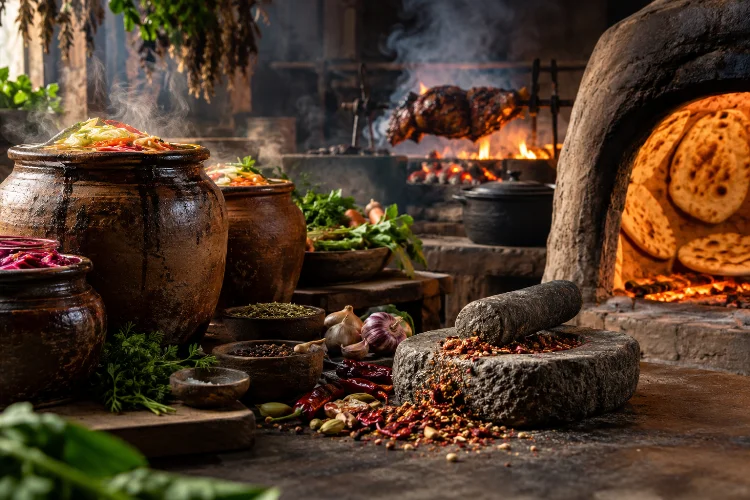
Think about meat slowly roasting over wood, vegetables fermenting in clay jars, spices being crushed by hand, or bread sticking to the scorching wall of a traditional oven.
These techniques may look simple, but they manipulate heat, moisture, microorganisms, texture, and time in surprisingly sophisticated ways.
Understanding how heritage cooking methods build deeper and more complex flavors helps explain why traditional dishes can be difficult to reproduce with shortcuts.
The ingredient list may be identical, yet changing the cooking process can completely alter the final result.
Many of these methods were originally developed for practical reasons. People needed to preserve seasonal harvests, tenderize tough ingredients, stretch limited fuel, or make food safer to store. Over generations, however, necessity became culinary knowledge.
Today, chefs increasingly rediscover those old techniques because they offer something technology cannot always replace: layers of flavor created gradually rather than instantly.
Fermentation Creates Flavor That Fresh Ingredients Cannot
Fermentation is one of the clearest examples of a practical preservation technique becoming a sophisticated flavor-building method.
FAO describes fermentation as one of the world’s oldest forms of food preservation, with traditions involving foods such as bread, cheese, vegetables, and beverages passed between generations for thousands of years.
During fermentaion, microorganisms transform sugars and other food components into acids, alcohols, gases, and aromatic compounds. The process can add sourness, umami, sweetness, funkiness, or entirely new aromas.
Think about the difference between fresh soybeans and miso, fresh cabbage and kimchi, or milk and aged cheese.
The original ingredient remains recognizable, but microbial activity creates extra layers.
Traditional fermentation also shows how geography influences flavor. Different climates, microorganisms, salt levels, containers, and local ingredients produce different results.
One example is ina sua, a traditional fermented fish from Central Maluku made using salt and stored for later consumption. Its distinctive flavor develops through a preservation method closely connected with local customs and food availability.
Modern chefs may use laboratory-style precision, but the principle remains ancient: let microorganisms do part of the cooking.
Fire Creates Complexity Through Browning and Smoke
Cooking directly over flames or hot coals looks primitive compared with a modern oven, but the flavor chemistry is remarkably complex.
High temperatures encourage browning reactions that create hundreds of aroma and flavor compounds.
Research on the Maillard reaction shows that interactions between sugars and amino compounds are major contributors to the desirable aromas produced when foods are heated.
This helps explain why grilled meat tastes different from boiled meat.
The same principle applies to vegetables, bread, nuts, and even fruit. Charring a cabbage, pepper, onion, or peach introduces roasted, bitter, caramelized, and smoky notes alongside the ingredient’s natural flavor.
Traditional wood fires add another dimension.
Different fuels create distinct aromas, while positioning food closer to or farther from the heat changes browning speed and moisture loss. Experienced cooks often control these variables almost instinctively.
Modern restaurants now install elaborate wood-fired grills to reproduce something cooks have understood for generations: fire is not merely a heat source. It is an ingredient.
Slow Cooking Allows Flavors to Develop in Stages
Some foods taste better when nothing is rushed.
Slow cooking gives ingredients enough time to soften, release flavor, absorb seasoning, and interact with one another. Tough meat becomes tender, onions lose their sharpness, spices mellow, and sauces gradually concentrate.
Traditional stews demonstrate this perfectly.
A dish may begin with toasted spices or browned meat. Aromatics are then added, followed by liquid, vegetables, herbs, and hours of low heat. Each stage contributes a different layer.
Slow cooking also changes texture, which strongly influences how we experience flavor.
A tough piece of meat cooked quickly may technically contain the same seasoning as a long-braised version, but they will not taste identical. Time changes how fat, collagen, water, and aromatic compounds behave.
That is why many heritage dishes resist shortcuts.
A pressure cooker can reproduce some effects much faster, but certain recipies are defined partly by gradual reduction, evaporation, and repeated adjustment.
In traditional cooking, time is often an ingredient.
Clay Pots Change How Heat and Moisture Behave
The cooking vessel matters more than many people realize.
Earthenware pots have been used around the world for centuries because they provide a particular cooking environment. They generally heat more gradually than thin metal and can maintain steady warmth during long cooking.
UNESCO’s documentation of Zlakusa pottery in Serbia describes traditional earthenware vessels used for bread, frying, and open-fire cooking, with communities associating food prepared in them with a distinctive taste.
Clay vessels are especially useful for dishes that benefit from gentle heat.
Rice, beans, meat, vegetables, and sauces can slowly cook together while moisture remains trapped inside the vessel. The gradual temperature change reduces the aggressive boiling that can break delicate ingredients apart.
Traditional clay cookware also encourages cooks to work differently.
Instead of constantly adjusting a burner, they learn how the vessel stores and releases heat. This relationship between material, fire, and timing becomes part of the recipe itself.
Modern cookware offers greater precision, but clay reminds us that the pot has always influenced what goes on the plate.
Traditional Ovens Produce Intense Heat in Unique Ways
Heritage ovens show another side of traditional heat control.
Tandirs and related clay ovens can reach very high temperatures, allowing bread or meat to cook extremely quickly.
UNESCO describes Azerbaijan’s tandir tradition as involving pottery ovens used for bread and sometimes meat and poultry, with knowledge passed through families by observation and practice.
Armenian lavash provides a similar example.
The thin dough is traditionally placed against the hot wall of a conical clay oven and can bake in roughly half a minute to one minute.
The result would be difficult to copy perfectly in an ordinary domestic oven.
High radiant heat creates blistering, browning, and rapid moisture loss on the outside while allowing the bread to remain flexible.
Modern pizza ovens use related principles. So do professional high-temperature bread ovens.
The equipment has evolved, but the culinary lesson remains the same: extreme heat used skillfully can develp flavor without necessarily drying food out.
Grinding and Pounding Release Flavor Differently
Using a mortar and pestle may look unnecessarily slow when a blender can pulverize ingredients in seconds.
The results, however, are not always identical.
A rotating blade cuts ingredients repeatedly. Traditional grinding stones and mortars crush, smear, and pound them. This can create a different texture and release aromatic oils gradually.
Traditional Mexican cuisine offers a famous example.
UNESCO recognizes ancestral techniques including nixtamalization alongside tools such as grinding stones and stone mortars as part of Mexico’s living culinary heritage.
Similar practices appear in sambal, curry pastes, pesto, spice mixtures, and many other foods.
Texture matters because flavor is experienced over time.
A perfectly smooth paste may release ingredients differently in the mouth compared with a coarse mixture containing small fragments of herbs, seeds, or spices.
This is why some cooks still pound spice pastes manually even when electric machines are available.
The slower technique is not automatically better, but it creates a different sensory result.
Salting, Curing, and Drying Concentrate Natural Flavor
Heritage food preservation often works by removing or controlling moisture.
Drying fruit concentrates sweetness. Curing meat intensifies savory flavors. Salting fish changes both texture and aroma.
Originally, these methods were essential because fresh food spoiled quickly.
But cooks eventually realized that preserved ingredients could taste more complex than their fresh versions.
Consider the difference between fresh grapes and raisins, fresh pork and cured ham, or fresh tomatoes and sun-dried tomatoes. Moisture loss concentrates flavor compounds while chemical and microbial changes can introduce additional aromas.
The technique also changes how an ingredient functions inside a dish.
A small quantity of cured meat can flavor an entire pot of beans. Dried mushrooms can intensify broth, while dried seafood can provide enormous savory depth to soups and sauces.
What started as food storage became intentional flavor concentration.
Modern gastronomy regularly borrows this concept through dehydrators, curing chambers, and controlled aging.
Heritage Techniques Preserve Knowledge as Well as Flavor
Traditional cooking is not simply a collection of old recipes.
It includes knowledge about timing, temperature, texture, ingredients, tools, seasons, and sensory judgment. Much of that information has historically been transmitted through observation rather than written instructions.
UNESCO emphasizes that food-related intangible heritage concerns practices and knowledge passed from generation to generation, rather than simply individual dishes. Around fifty culinary practices are represented in its intangible cultural heritage framework.
That distinction matters.
A recipe might tell you to cook something for thirty minutes, but an experienced cook may judge readiness by smell, sound, texture, or how quickly steam escapes from the pot.
These forms of knowledge are difficult to capture in measurements.
Modern food science helps explain why traditional methods work, but heritage cooking often reached useful solutions long before scientists described the chemistry.
The strongest modern kitchens increasingly combine both approaches: inherited sensory knowledge and precise scientific understanding.
Heritage cooking methods create deeper flavor because they transform food gradually and in several different ways at once.
Fermentation introduces acids and savory compounds, fire creates browning and smoke, while slow cooking develops tenderness and concentration.
Clay pots and traditional ovens control heat differently, and grinding, curing, drying, and salting manipulate texture and aroma in ways modern shortcuts may not perfectly reproduce.
These methods also carry generations of accumulated culinary knowledge. Their value is not simply that they are old, but that they still work.
Next time you prepare a familiar dish, experiment with one tradtional technique instead of choosing the fastest option.
Ferment something, grind spices by hand, cook over charcoal, or give a stew an extra hour. The preperation may take longer, but the flavor may explain why these methods survived for centuries.
